Showing posts with label Obamacare. Show all posts

Sunday, April 2, 2017

On Being Stubborn - House Freedom Caucus

[From Bill Lifka - Graphic by Ira]
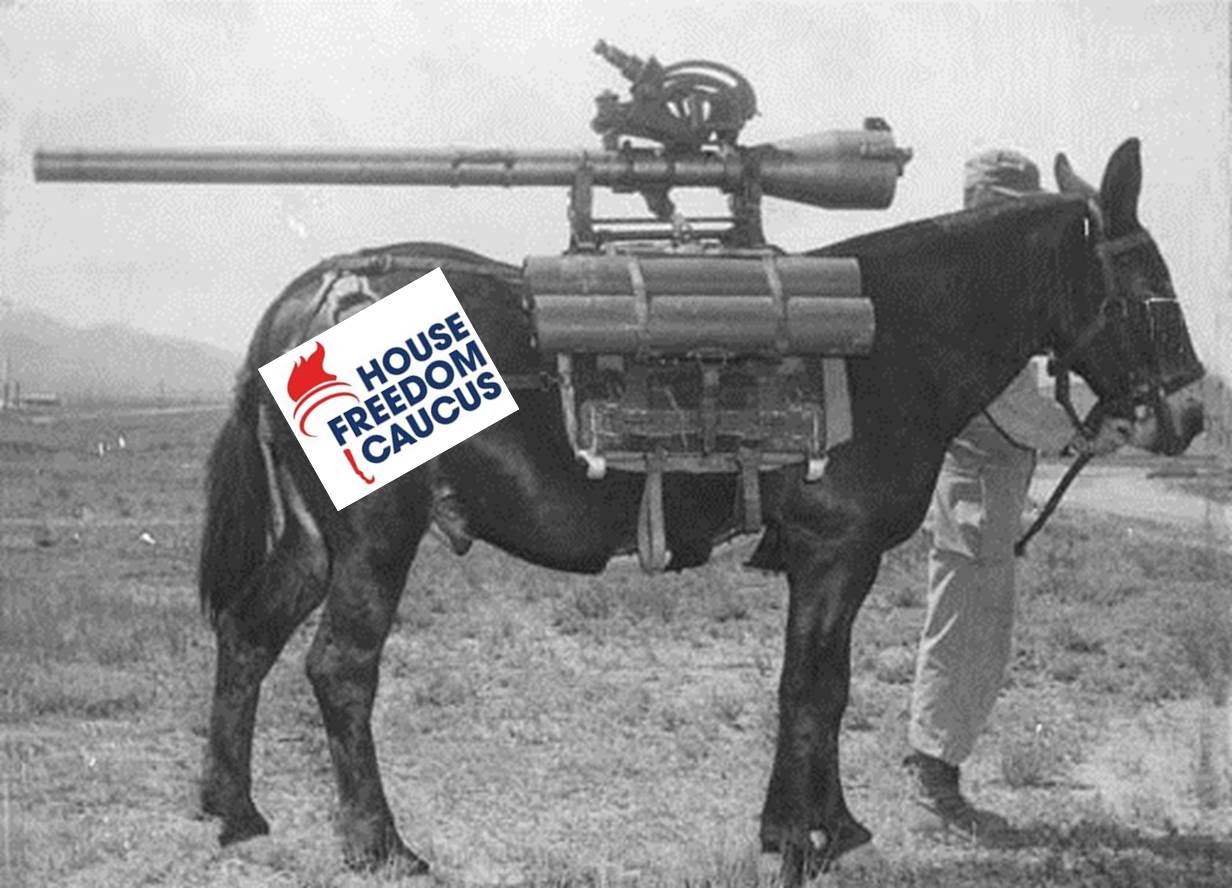
MAX THE ARMY MULE

I knew a sergeant at The Artillery School who’d served from before WWII when horse drawn artillery still existed. He’d served in a mountain battery that used mules to carry the small howitzers in two pieces. The tube was placed on the back of one mule and the carriage with wheels on another mule. The ammunition and other battery equipment were also carried by mules. Mules were chosen over horses because they were stronger, had staying power and were sure-footed on mountainous terrain.

On the negative side, some mules are downright stubborn and unwilling to do their jobs if doing so doesn’t suit their fancy at the moment. In Sgt. Clancy’s battery, one of the mules, Max, was noted for being most stubborn of all. His habit was to rear up on his hind legs when the job or situation wasn’t to his liking. 

On or around Fort Sill there are no mountains but there is rolling terrain. One fairly big hill, called Signal Mountain, rises 1200 feet or so over its base at an increasingly higher slope near its top. A punishment hike or two up the hill was a regular Saturday event for me when I attended OCS. (Actually performed at a “paratroop shuffle”.) 

For the mountain artillery, Signal Mountain was the only way to keep its mules in shape. On one fateful day, Sgt. Clancy’s battery was on its way up the mountain. Max was having one of his more ornery days and had been kicking and rearing from the moment he’d been led from the corral. His handlers couldn’t let him get away with bad behavior on this occasion or he’d be worse the next time.

Eventually, Max settled down sufficiently so a carriage could be loaded on and he fell in the line of mules heading out on the trail. As I know from personal experience, the trail up Signal Mountain is narrow and falls off sharply to one side. There’s not much room for error, which mules seem to know instinctively. With the exception of Max, all the mules settled into the climb at a steady pace, placing their hoofs with practiced care. 

Max knew better but he continued to show his dissatisfaction by skittering around and tossing his head. Finally he reared up on his hind quarters, a tremendous feat considering the load he was carrying. Unfortunately, he rose past the point where he exceeded the center of gravity (his and his load), fell backward and rolled down the mountain upside down atop the carriage wheels accompanied by the cheers of his handlers. Max was stubborn to his end.

PERSEVERING VS BEING STUBBORN

There’s a difference between persevering and being stubborn. When one keeps trying to attain a goal using other than previously failed actions, one’s persistence is considered to be strength. When one keeps trying the same failing action, it’s called stubbornness and stupidity. 

That brings me to my subject which is current historic levels of stubbornness and stupidity in Congress, as opposed to the usual stubbornness and stupidity that’s a hallmark of those hallowed chambers.

It might have been better if the Republican-led House had practiced with a few easier initiatives before introducing a bill that began changing Obamacare. I use the word “began” because the plan of the Speaker and his associates was to effect a change in three stages. It was quite certain Democrats in the Senate would vote 100% against any Republican sponsored health bill out of the House because Democrats in Congress and those not yet removed from Executive Branch departments have been waging a fierce war against all Republican initiatives since the election. 

It makes no difference that the country needs adult leadership right now desperately; the main goal for Democratic officeholders is to let their constituents know they are bent on revenge for having lost the White House and the sweetest revenges for most Democrats are preventing any changes to Obamacare and preventing the appointment of Neil Gorsuch to the Supreme Court. Last week the Democrats succeeded in the first of these and next week they hope to succeed in the second. 

Actually, it wasn’t Democrats who defeated Obamacare replacement. It was 25+/- Republican congressmen who call themselves the “Freedom Caucus.” They consider themselves to be “true” Conservatives and, therefore, are “real” Republicans who take Party principles seriously. 

As far as I can figure out, I share all the major beliefs of these guys but I want you to know I think they were stubborn and stupid on this occasion as they were back when the previous Speaker gave up and retired rather than fight them as well as a President (Obama) out to destroy the Republican Party. 

In my view, Ryan had a correct strategic plan that addressed the Senate process and the bare majority held by Republicans in that house. It was Freedom Caucus Republicans who would not follow the leadership again because they didn’t think their plan went far enough.  

I had the opportunity to talk to my Congressman just after the fiasco. I told him he was wrong and needed to change his ways. He has a great name, an impressive appearance and a pat answer, as I had expected. He is a stereotypical politician: 18 years in the Florida House, 10 years in the Florida Senate, 6 years (so far) in the U.S. House. In each of these offices he ran from two different districts because of redistricting; he likes the job. I rated his reason for blocking Ryan’s bill as unadulterated BS, although he argued well. He denied he’s a member of the “Freedom Caucus”. (That caucus ran him as a candidate for speaker against Boehner.) He argued the Ryan bill didn’t go far enough and denied Freedom Caucus changes would prevent Senate passage. 

He was wrong or betting I wouldn’t know. He said maybe it was good Obamacare would continue since it would fail and that would force Americans to embrace a truly great replacement. When I mentioned “party loyalty”, he denied that was important. He was wrong again. I know some really smart Conservatives who think like my (new) Congressman. I just don’t get why they like what I think is all bad. 

Any improvement in Obamacare would be better but still bad because any federal government involvement in health care will cause it to be ineffective. To let Obamacare fail (as it will) is just plain irresponsible and Republicans will get the blame. 

Democrats in the Senate are as bad as the wrong-headed Republicans in the House. They have acted like idiots in their questioning Neil Gorsuch, who has been rated as an ideal candidate for the Supreme Court by legal organizations ranging from Liberal to Conservative. His extensive service as a federal judge provides unwavering testimony to his fairness in upholding the law and not making the law, as Liberals expect of them. Senate Democratic leaders rant and rave in their frenzied attempt to defeat him. (Or anyone Trump might name.) The basis of every argument against Gorsuch is that Democrats expect judges to make decisions on ideological grounds not on the law as written. They are too stupid to realize that would bite them in the ass in due time.

The problem of the Freedom Caucus is the same as that of the Democratic Caucus in the Senate. Although they are directly opposed on all political issues they share a monumental stubbornness and lack even the barest smidgen of modesty in their belief they are 100% right and any opposition is 100% wrong. I wonder if there’s a steep hill near Washington DC on which we could gather these folks together and tie wheels on their backs. 

Bill Lifka

Thursday, October 25, 2012

Uncle Sam's Illness

"Dr. Mitt", Uncle Sam, and "Dr. Barry"
A Responsible Approach vs Hopey Changey Happy Pills

[from billlifka[ I have a deceased uncle (let’s call him Sam) who was a heavy smoker. He was feeling poorly and a doctor diagnosed his condition as an advanced case of lung cancer. Sam didn’t want to hear that so he went to several other doctors who delivered the same verdict, along with the prognosis of an early, painful death.
 
One of these, Doctor Mitt, was quite experienced in the field and had cured many cancer patients before. He promised Sam that he could be cured if he were willing to undergo treatment that would be very uncomfortable for a time but would return him to robust health as he had enjoyed before he became addicted to smoking. The treatment would require that Sam cease smoking immediately and submit to chemotherapy and radiation. His hair would fall out, temporarily, he’d be extremely nauseous most of the time and he’d lose much weight. On the other hand, Dr. Mitt would prescribe modest doses of pain killers and a special diet of food and food supplements that would build up Sam’s total body to offset much of the damage to the localized cancer area.
 
Sam considered this advice but sought an easier solution. 

In all professions, there are practitioners who tell their clients what they want to hear. Usually, they are successful in their practices since most humans want to hear what they want to hear. And so it was that Sam was able to find other doctors who told him just the opposite of what Dr. Mitt and others of his persuasion had told him.
 
Principal among these was Dr. Barry who was a glib, handsome devil who was very popular with his patients, especially the ladies. Dr. Barry said all that discomfiture was unnecessary and, most likely, was bad; even a little bit of suffering caused patients to lose hope and hope was known to be the best medicine for any kind of ailment. Giving up smoking, according to Dr. Barry, was also bad; resultant unhappiness was another cause of the loss of hope. He prescribed stronger pain killers that produced a euphoric feeling in Sam for several months. 

After a few months, the stronger pain killers and the continued smoking didn’t make Sam any better. In fact, his condition steadily worsened and he spent an extremely painful eight months until his early death. To the end he recommended Dr. Barry to friends and associates as a doctor who cared deeply for his patients. 

This is a true story but I’ve changed the names of my uncle and the doctors to protect the guilty and the innocent. You might have noticed the similarity between my real uncle’s story and the on-going story of our Uncle Sam. My uncle’s immediate family members were enablers to him in his choice of a comfortable short term over a successful long term cure. Currently, Americans have the opportunity to enable their Uncle Sam to continue in his rotten habits that feel good in the very short term but will lead to his painful death in the slightly longer term. They have an alternate opportunity to restore him to full health and a long life. Which will it be? 

This analogy may offend some but it’s dead on. Just because one is a lemming doesn’t mean that one must follow one’s leader over a cliff. Many lemmings are credits to their species and have the intelligence to know a cliff is ahead and it’s time to ease themselves to the sides of their pack and not get swept over in the crowd. It will allow their species to survive, which should be high on their list of instincts. Their next step should be to select a leader with more common sense.
 
billlifka                                  

Tuesday, September 25, 2012

Affordable Food Care Act

Now that the Affordable Healthcare Act (aka "Obamacare") has been declared constitutional by the US Supreme Court, and has gone into effect, it is high time we move into the even more important realm of FOOD CARE.

After all, most of us EAT three times a day (some five times or more) while most of us only require health care a few times a year. If we are deprived of health care, most of us will live on for years, but, if we are deprived of food, even the strongest of us we will survive for only days (or three weeks max).

Having established that FOOD CARE is more critical than Healthcare, let us come up with a solution that will reduce costs and improve quality. Let us take the unfair profits away from the blood-sucking supermarkets by establishing a single-payer food program that will assure the healthiest foods at the lowest possible cost to us and our fellow citizens (and legal and illegal aliens as well, of course).

For example, there are dozens of supermarkets in my Zip Code, all of them profit-based and all making fat profits selling food that is often unhealthy and that has made many of my neighbors sickly and obese. Each of these supermarkets is earning exorbitant profits by jacking up their prices to the highest levels possible. Why should there be more than one food supplier in any given Zip Code? Why should we, the consumers, have to pay the bloated overhead of all these duplicated stores?

THE FOOD CARE SOLUTION

The advent of email, and unfair competition from profit-making UPS and FedEx, has nearly destroyed the United States Post Office. Most of their buildings are underutilized and they require large subsidies to continue operation and pay their employees.

The FOOD CARE solution is OBVIOUS. Turn FOOD distribution over to the real delivery experts at the US Post Office and FOOD acquisition over to the real nutrition experts at the US Agriculture Department. Make fresh, healthy food available for free, delivered seven days a week directly to every home in America. Letter Carriers will once again have full mailbags. Since they already deliver mail six days a week, adding a seventh day will not raise costs by more than 15%.  By eliminating profits, costs will go down, and by eliminating unhealthy foods, there will be large savings in the public health care system.

Everyone will be required to purchase Food Care Insurance and those who refuse to do so will be charged a $500 tax per year (but only if they can afford it). In that way:

- Everyone in our great country will be assured three square meals a day!

- Fresh food will be delivered daily, eliminating the cost of weekly trips to the supermarket and the expense of household refrigerators and freezers as well as the Global Warming imposed by the energy demands imposed by unnecessary travel and household appliances.

- And disabilities due to unhealthy, fattening and sugar-filled foods will be a thing of the past!

- And health-care costs will go down as life-expectancy goes way up!

- And, the US Post Office, a cherished memory of government services at their best, will survive and prosper!

What could possibly be wrong with this plan?

Ira Glickstein

UPDATE 27 Sep 2012 
 
Howard Pattee posted a comment on 26 Sep regarding US Health Care costs, and why they are so much higher than other countries. I did some research on why US health care costs have risen so fast and concluded that about half the increase is due to medical technology advances that were not available in the past and that are both increasing lifetimes and are very expensive.

However, it appears (see chart below) that the other half of the rapid increase in costs is driven by government programs where a third-party (US Taxpayer) is paying and the consumer gets the care for "free" so they have no reason to shop around or limit their consumption and, as a result, suppliers have no incentive to contain costs. This almost completely eliminates normal market forces that balance supply and demand according to cost and affordability.

My (sarcastic) example of "free" food supplied by the government was meant to show how ridiculous it would be to remove market forces that improve quality and convenience and keep costs affordable.  Milton Freedman said that if the government was put in charge of the Sahara Desert, within six years there would be a shortage of sand! And the cost of sand would skyrocket as the quality declined.

In other countries, notably the UK, medical costs are contained by rationing care based on a limit of about $40,000 per additional Quality-Adjusted Life Year (QALY). If a given procedure would increase the lifetime and quality of life of the recipient, but exceeds the cost limit per QALY, an alternate, less expensive procedure, such as palliative care, will be provided.

For the record, I wrote about the QALY concept way back in 2009 see http://tvpclub.blogspot.com/2009/09/end-of-life-honest-brokers-not-death.html and I support it for public medical expenditures in the US.

(More recently, see http://tvpclub.blogspot.com/2011/02/runaway-trolley-applied-to-end-of-life.html, and http://tvpclub.blogspot.com/2012/08/quality-of-life-and-health-related.html for my views. Unless we thoughtfully address End of Life and rationing of health care for people with chronic and terminal conditions, we will never be able to control overspending on health care. A false sense of "compassion" and "fairness" and "caring" will continue to bankrupt the USA.)

Wednesday, March 3, 2010

Wasted Funds??

Another way we can stretch our health care resources is to do away with the funding of useless research. This morning I heard a news report about a study linking "purpose in life" and Alzheimer's. Out of curiosity I looked up what I could about the study. I googled one of the authors (Patricia Boyle) and found a significant number of statistical studies have been funded by NIH which investigate various psychosomatic risk factors. Could we find better medical uses for the the allocated funds? Is this information of any value? -Joel

[The following is from: http://archpsyc.ama-assn.org/cgi/content/short/67/3/304]

Effect of a Purpose in Life on Risk of Incident Alzheimer Disease and Mild Cognitive Impairment in Community-Dwelling Older Persons


Patricia A. Boyle, PhD; Aron S. Buchman, MD; Lisa L. Barnes, PhD; David A. Bennett, MD


Arch Gen Psychiatry. 2010;67(3):304-310.


Context Emerging data suggest that psychological and experiential factors are associated with risk of Alzheimer disease (AD), but the association of purpose in life with incident AD is unknown.


Objective To test the hypothesis that greater purpose in life is associated with a reduced risk of AD.


Design Prospective, longitudinal epidemiologic study of aging.


Setting Senior housing facilities and residences across the greater Chicago metropolitan area.


Participants More than 900 community-dwelling older persons without dementia from the Rush Memory and Aging Project.


Main Outcome Measures Participants underwent baseline evaluations of purpose in life and up to 7 years of detailed annual follow-up clinical evaluations to document incident AD. In subsequent analyses, we examined the association of purpose in life with the precursor to AD, mild cognitive impairment (MCI), and the rate of change in cognitive function.


Results During up to 7 years of follow-up (mean, 4.0 years), 155 of 951 persons (16.3%) developed AD. In a proportional hazards model adjusted for age, sex, and education, greater purpose in life was associated with a substantially reduced risk of AD (hazard ratio, 0.48; 95% confidence interval, 0.33-0.69; P < .001). Thus, a person with a high score on the purpose in life measure (score = 4.2, 90th percentile) was approximately 2.4 times more likely to remain free of AD than was a person with a low score (score = 3.0, 10th percentile). This association did not vary along demographic lines and persisted after the addition of terms for depressive symptoms, neuroticism, social network size, and number of chronic medical conditions. In subsequent models, purpose in life also was associated with a reduced risk of MCI (hazard ratio, 0.71; 95% confidence interval, 0.53-0.95; P = .02) and a slower rate of cognitive decline (mean [SE] global cognition estimate, 0.03 [0.01], P < .01).


Conclusion Greater purpose in life is associated with a reduced risk of AD and MCI in community-dwelling older persons.


Author Affiliations: Rush Alzheimer's Disease Center (Drs Boyle, Buchman, Barnes, and Bennett) and Departments of Behavioral Sciences (Drs Boyle and Barnes) and Neurological Sciences (Drs Buchman, Barnes, and Bennett), Rush University Medical Center, Chicago, Illinois.