Although I don't go along with most of Jon Stewart's ideology, he can be very insightful. WATCH THE VIDEO. This is very thought-provoking! Vi and I will be away to Seattle and Alaska for a couple weeks with limited internet access during parts of that period. We'll be visiting our Seattle daughter and son-in-law and our grandsons. Our Atlanta and Andover daughters and sons-in-law and our three granddaughters will be with us as we cruise the inside passage and visit Seward, Denali, and Fairbanks in Alaska. Please continue to post Comments to the Blog. I would very much appreciate it if Blog Authors would use their special powers to start some new Topics. advTHANKSance!
Ira Glickstein
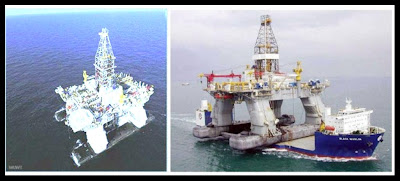 The photo on the left shows the ill-fated Deep Water Horizon oil rig prior to the recent disaster. On the right, you can see what the lower part of a deep water rig looks like. In this case is it a sister rig, the Nautilus, being transported by a heavy-lift ship. [Click on photo for larger image.] See more photos and information at WattsUpWithThat. There has been lots of information and quite a bit of mis-information about the April 20th explosion and the release of millions of gallons of crude oil into the Gulf of Mexico. Prior to reading the linked source above, I had the impression these rigs are tethered to the bottom and that the Horizon had safety features that were inferior to more modern offshore rigs. Both of these impressions appear to be false. "The rig represents the cutting edge of drilling technology. It is a floating rig, capable of working in up to 10,000 ft water depth. The rig is not moored; It does not use anchors because it would be too costly and too heavy to suspend this mooring load from the floating structure. Rather, a triply-redundant computer system uses satellite positioning to control powerful thrusters that keep the rig on station within a few feet of its intended location, at all times. This is called Dynamic Positioning."Someone told me this rig did not have an automatic shut-off in case of an accident. That is also incorrect. "With a floating drilling rig setup, because it moves with the waves, currents, and winds, all of the main pressure control equipment sits on the seabed – the uppermost unmoving point in the well. This pressure control equipment – the Blowout Preventers, or ‘BOP’s' as they’re called, are controlled with redundant systems from the rig. In the event of a serious emergency, there are multiple Panic Buttons to hit, and even fail-safe Deadman systems that should be automatically engaged when something of this proportion breaks out. None of them were aparently activated, suggesting that the blowout was especially swift to escalate at the surface."
Far from reassuring me that this accident was preventable with better safety equipment -or at least that the resultant large spill could have been avoided- , it now seems to me that even the best offshore drilling technology is likely to result in occasional disasters. When human beings are involved there will always be mistakes and accidents that overwhelm any supposed fail-safe system. If I lived along the shorelines of Lousiana or Mississippi or Texas where many rigs currently operate, or along the Florida coast where President Obama recently authorized drilling (since suspended), I would be very, very worried. If I was invested in the commercial fishing industry or in beach-related tourism, or employed there, I would try to get out. I have been on the "drill baby drill" bandwagon for some time but this disaster has me thinking about getting off. Baring a loss of pressure or the sudden self-sealing of the leak, it will be weeks or months before the oil stops leaking. "In the coming weeks they will move in at least one other rig to drill a fresh well that will intersect the blowing one at its pay zone. They will use technology that is capable of drilling from a floating rig, over 3 miles deep to an exact specific point in the earth – with a target radius of just a few feet plus or minus. Once they intersect their target, a heavy fluid will be pumped that exceeds the formation’s pressure, thus causing the flow to cease and rendering the well safe at last. It will take at least a couple of months to get this done, bringing all available technology to bear."
So, here I sit in Central Florida, an hour from either the Gulf or the Atlantic coastline, trying to balance higher fuel bills for myself if we don't drill vs authorizing more domestic drilling and endangering the livelihoods and investments of coastal employees and investors. An alternative would be continued dependence on foreign oil but that comes with a cost in American blood to protect that access. Then there is nuclear power with attendant risks of terrorist attack or accidental release of radiation, plus the problem of nuclear waste. France has done quite well, so far, with nuclear, but, even if we go whole hog down that road, it will be decades before nuclear can impact our need for traditional energy sources. Wind, solar, water, tides and other alternative clean energy sources are -at least now- inadequate to make much of an impact on our appetite for energy. Conservation is also good I tell myself as I do 40-50 miles per week on my bicycle and ride around in my electric golf cart and hybrid Prius, but it too is inadequate to save much energy. Finally, there is coal, and the possibility of what President Obama calls "clean coal technology". The US has lots of coal. The problem is continued release of CO2 and worries about continuing global warming due to the "greenhouse" effect. Let us hope that we skeptics and lukewarmers are correct that the dangers of CO2 have been overblown and that the recent stabilization in global temperatures, and perhaps a bit of global cooling, will hang on for a while. Ira Glickstein
 The latest issue of WIRED Magazine features Tricked-Out Golf Carts Swarm Florida Communities, with special emphasis on The Villages, FL, where we live. They make the point that golf carts might just be the future of energy-efficient and safe transpotation, at least for the growing numbers of senior citizens.The photo to the left was taken by my wife, Vi, at a golf-cart parade here in The Villages. Yes, there is a golf cart somewhere under that Christmas tree! There are several interesting photos in the linked story in WIRED. The story makes it appear that most golf carts here are "tricked-out" and sell for $10,000 or more. The photos in the magazine show carts that look like classic cars or are illegally geared to go above the legal limit of 20 MPH. The truth is that most of us drive pretty-much "plain vanilla" golf carts. Ours for example, is a 2001 that served a year or two at a golf course and was rebuilt for us in 2003, with an added rear seat, and cost us about $4,500. Here is a selection from the WIRED story:
It's 9 am in the Villages—practically midday for the chipper residents who often rise at four—as I drive my LC3 down to the Colony Cottage. I'm due for a quick primer in pickleball—sort of a Ping-Pong/tennis hybrid. I arrive to find dozens of fit retirees dashing around the courts, the ubiquitous row of shiny EVs [Electric Vehicles] parked outside.
There will be more carts fighting for space here soon. While the rest of the country wallows in the recession, homes are still being built and sold in the Villages at a rapid clip. The population of the community is expected to hit 100,000 by 2014.
The Villages embodies what environmentalists have been waiting decades for—a glossy future powered by electric vehicles. The slightly messy reality, though, is that it's not powered by pristine futuremobiles but by gaudy, overclocked golf carts.
But the lesson of the Villages isn't just about the vehicles we're driving—it's about where we're driving them. The future of transportation should be focused on the quick jaunts that make up most of our day-to-day driving.
The Villages is for people who've lived long enough to know that what they want now is a warm breeze in a quiet, open ride—going fast enough to hit both the golf course and the Walmart in the same afternoon but slow enough to take in the scenery along the way.
As my octogenarian opponent deftly whacks the pickleball past my reach, I look up to catch a glimpse of the future on the horizon. It's a gray-haired guy with a backward cap, cruising in his cart past a brand-new community center. A golden retriever stands on the passenger seat, tail wagging, and an American flag is displayed proudly right where the gas tank should be.
Ira Glickstein
  A Reuters story today says "Google Inc is closing in on its goal of producing renewable energy at a price cheaper than coal..."That is GREAT news! I'd bet that Google and other profit-making enterprises, spending moderate amounts of their own money, are much more likely to hit "pay dirt" that all the government investment in the world. "Google's Green Energy Czar Bill Weihl said the odds of success had gone up in the last year or so from a long shot to a real possibility of demonstrating working technology in a few years. 'It is even odds, more or less, I would say,' he said in an interview with Reuters. 'In, you know, three years, we could have multiple megawatts of plants out there.'"Google plans to use "solar thermal" technology that generates steam to drive electrical generators, rather than photo cells that turn sunlight directly into electrical power. Wikipedia has a fine item about solar thermal and they include a number of photos. The first photo above shows a parabolic trough of mirrors. They reflect sunlight to a fluid pipe that is most likely inside an evacuated tube to reduce convective heat loss. The second photo above shows an array of flat mirrors that reflect sunlight to a central collector. In both cases, the collected heat is turned into steam to drive electrical generators. A SOLUTION TO GLOBAL WARMING?As readers of this blog know, I am a "realist" on global warming. I acknowledge that we have had significant actual warming of about 0.5ºC over the past 150 years and I am concerned about the rapid increase in atmospheric CO2. While I do not believe human activities are responsible for more than about 0.1ºC of this warming, and I do not think we can do much about that 0.1ºC on a practical level, I do believe we should take conservative actions to reduce the continuing rapid rise of CO2. Solar energy (along with nuclear, wind, and biomass) is one carbon-free avenue we should explore. I commend Google for their work in this area! Ira Glickstein
 Also see the Updated version of the sunspot minimumWith thanks to http://wattsupwiththat.com/2008/02/13/where-have-all-the-sunspots-gone/ and appologies to Pete Seeger: Where have all the sunspots gone? NA-SA search-ing,
Where have all the sunspots go-ne? NASA don't know.
Where have all the sunspots gone? Global Cooling, anyone?
Will NASA ever learn? Will NA-SA ev-er learn?
Where has all the carbon gone? Green-house gas-es,
Where has all the carbon go-ne? Come down as snow!
Where has all the carbon gone? Heating houses, everyone,
Will NASA ever learn? Will NA-SA ev-er learn?
Where has Global Warming gone? Point not tip-ping,
Where has Global Warming go-ne? Its gonna slow.
Where has Global Warming gone? Normal seasons of the Sun,
Will NASA ever learn? Will NA-SA ev-er learn?As Yogi Berra famously observed, "It's tough to make predictions, especially about the future." NASA CHANGES PREDICTIONS, THEN CHANGES THEM AGAIN
When NASA scientists make predictions about the long-term future (six to twelve years) you don't expect them to make drastic changes in only a few months. Yet, they just have! Back a few months ago (October 2008, see left side in photo above) NASA predicted that the upcoming sunspot cycle would peak at a higher level than the previous cycle which recently ended. The previous cycle peaked at around 120 in the year 2000. NASA predicted the upcoming cycle would peak at around 137 early in the year 2012, an increase of about 15% over the past cycle. As the diagram above indicates, NASA smoothes short-term jagged excursions in sunspot counts and plots the yearly average as a smoothed bold curve. They also provide a range of about plus and minus 20% as indicated by the smooth curves above and below the average. All predictions refer to the smoothed averages. This month (January 2009, see right side in photo above) NASA revised their prediction and now say the upcoming cycle will peak at a level some 30% below their prediction of only three months ago! They say it will peak at about 104 late in the year 2012, a decrease of about 15% below the past cycle. That is a grand total of 30% below their prediction of only three month ago! If we go back a few years ago, to 2006, they were predicting a peak of 145 for the coming cycle, so the latest prediction is more than 40% lower than their original one. OY! WHY THE CHANGE IN NASA PREDICTIONS? Back in 2006 NASA predicted the previous cycle was ending and the next would begin in late 2006 or early 2007. Well, here it is 2009 and the next cycle has not begun! That delay is the reason for the change in predictions. The next sunspot cycle was expected one or two years ago but has yet to materialize. This is our US Government taxpayer money at work! IRA'S PREDICTIONS
I am no weather or climate expert, but I think I can do better than NASA. My prediction, shown in the annotations above, is that the upcoming cycle will peak at about 80 in the year 2013 or perhaps even 2014. Note that my prediction is that the peak will be reached a year or more later and will be near or below the lowest edge of the NASA plus and minus 20% band for NASA's October 2008 prediction. Please make a note of my prediction and, in 2013 or 2014, let me know how I did! Of course, anything posted to the WWW becomes a more or less permanant record so there will be proof if I am correct (and I will appologize if I am wrong). WHY ARE SUNSPOT CYCLES IMPORTANT? Sunspot cycles are about 11 years long, with some as short as 9 years and others as long as 14. It turns out that average global surface temperatures are correlated with the number of sunspots and inversely correlated with the length of the sunspot cycle. Although human activity, such as burning formerly sequestered carbon from petroleum, coal and natural gas and releasing heat energy and CO2 into the environment, accounts for a substantial fraction of the current Global Warming trend, most climate change is due to the natural cycles in the activity of the Sun and changes in the orbit and tilt of the Earth.  The above diagram, from Wikipedia, shows how sunspot activity has varied since the year 1600. According to NASA the period from about 1645 to 1715, called "Maunder Minimum" or "the Little Ice Age", corresponded to a time of little sunspot activity. The "Dalton Minimum" in the early 1800's was a shorter and smaller drop in solar activity. These periods saw considerable Global Cooling. The period since 1940 has seen relatively higher solar activity that corresponds to the observed Global Warming. POSSIBLE BENEFIT OF DECREASED SUNSPOT ACTIVITY If, as now appears possible, sunspot activity is actually decreasing, and if that trend continues (two big "ifs") we may experience a reduction in the rate of increase in Global Warming and, who knows, perhaps a bit of Global Cooling! This could give us time to control our energy usage and switch to more carbon-neutral sources such as wind, water, biomass, direct solar, and nuclear, along with recycling and conservation. We may also benefit from the affects of globalization in raising living standards and reducing fertility rates. However, so long as population continues to increase, along with worldwide standards of living, it is inevitable that we will continue to release more heat energy and sequestered carbon into the environment for the forseeable future. The only "hope" we have to reverse this trend would be a nuclear war or a genetic engineering disaster that might block the sun for a season and/or reduce the population drastically. No one would wish for such a "solution". Thus, unless the apparent reduction in sunspot activity leads us to an extended global cooling or temperature-neutral period, we will have to learn to live with a warmer Earth. Ira Glickstein
 One key issue in the Canadian parliamentary elections this week was the Liberal Party leader, Stéphane Dion's newfound support for a "carbon tax". This is a shift for Dion. Previously, only Canada's Green Party supported that type of tax. Election results indicate the "carbon tax" is a loser. The Conservatives gained 16 seats and the Liberals lost 19. The Conservatives still lack an absolute majority, holding 143 seats to the Liberals 76, with 89 in the hands of three minority parties, the Quebec separatists (50), the New Democrats (37), and the Independents (2). The Greens have zero seats. As readers of this Blog know I favor a punitive tax on burning of sequestered carbon (oil, gas, coal) as a way to encourage development of nuclear energy and renewable energy (water, wind, biofuels, ...). All energy used on Earth (with the exception of nuclear) is originally from the Sun. Some of this energy was delivered to the Earth from the Sun eons ago and was sequestered in the form of carbon and hydrocarbons found in underground deposits of oil, gas, and coal. That carbon was removed from the Earth's atmosphere and, until the industrial age, remained there.  We are now burning increasing amounts of sequestered carbon to energize our mechanized civilization. It is spewing into the atmosphere in the form of man-made carbon dioxide, a "greenhouse gas". Increased levels of carbon dioxide have been detected and are certainly responsible for some percentage of the rise in worldwide temperatures. (The majority of the temperature rise is probably due to Sun and Earth-orbit effects that are beyond our control, but we can control some of the "greenhouse" effects of release of sequestered carbon.) Nuclear energy is carbon-neutral, and it should be used to reduce cabon emissions, but it is, ultimately, non-renewable. Until earlier this year, sequestered carbon energy from oil, gas, and coal was considerably less expensive than alternative fuels, which discouraged development of more wind, solar, nuclear, and other sources. The recent spike in oil prices altered that equation, and, as energy prices skyrocketed, many people changed their driving habits and gasoline usage dropped a bit. Interest in alternative energy sources increased. However, the recent worldwide economic downturn has driven oil prices from about $140/barrel back down to about $70/barrel, half their peak levels. If they remain at these low levels, development of alternate energy will be endangered. We need to reduce our dependence on sequestered carbon, a non-renewable resource. We must instead power our civilization with the renewable energy that arrives daily from the Sun. As you know, hydroelectric energy is driven by the Sun, which evaporates water from the sea and delivers it as rain that drives our rivers. The Sun also powers the weather, which causes winds that we can capture with wind turbines. Biofuels (including corn and sugarcane-based ethanol) are also powered by the Sun. When we burn biofuels we do release carbon into the atmosphere, but it is carbon that was recently removed from the atmosphere when the crops were grown. As a long-term goal, we may be able to grow crops and then bury them as a way to re-sequester carbon out of the atmosphere. There are two ways the government can encourage alternative energy. The first is to subsidize it and the second is to punitively tax sequestered carbon as a way to make alternative energy relatively less expensive and allow market forces to do their magic. I favor the second approach. An added benefit of a punitive tax on sequestered carbon is that it will increase the rewards for energy conservation. According to WikipediaThe intention of a carbon tax is environmental: to reduce emissions of carbon dioxide and thereby slow climate change. It can be implemented by taxing the burning of fossil fuels — coal, petroleum products such as gasoline and aviation fuel, and natural gas — in proportion to their carbon content. Unlike other approaches such as carbon cap-and-trade systems, direct taxation has the benefit of being easily understood and can be popular with the public if the revenue from the tax is returned by reducing other taxes. As a C-mind, I find it somewhat distressing that my support of a punitive "carbon tax" puts me with the Green Party and Liberal Party of Canada, and other L-minds like President Bill Clinton, and Senators Al Gore and John Kerry. However, Wikipedia notes: A carbon tax is an indirect tax — a tax on a transaction — as opposed to a direct tax, which taxes income. As a result, some American conservatives have supported such a carbon tax because it taxes at a fixed rate, independent of income, which complements their support of a flat tax.[2]
Prices of carbon (fossil) fuels are expected to continue increasing as more countries industrialize and add to the demand on fuel supplies. In addition to creating incentives for energy conservation, a carbon tax would put renewable energy sources such as wind, solar and geothermal on a more competitive footing, stimulating their growth. Former Federal Reserve chairman Paul Volcker suggested (February 6, 2007) that "it would be wiser to impose a tax on oil, for example, than to wait for the market to drive up oil prices."[3]
Ira Glickstein
 In the long run, however, natural resources are what give power to a society, and modern societies are not isolated like primitive tribes. Consequently, economic power, defined as fungible resources, is necessary to support modern military power. [Emphasis added]
"Fungible" means "interchangeable" meaning the consumer or user cannot tell the difference between the product from source A or source B. While looking it up I came upon the above Dilbert cartoon that states: Oil is a fungible commodity, the capitalist system virtually guarantees that you'll end up buying the lowest cost oil from sources unknown to you. [Emphasis added] True, but does that negate Dilbert's desire to buy a fuel efficient car or the newly-forming national consensus that we need more domestic sources of oil and other energy? I think not. Energy conservation, if it is done in a rational way, should save us money in the long run, regardless of what other nations may do. Since oil (and by extension any other form of energy that is interchangeable with oil) is fungible, any bit we save will reduce worldwide demand and therefore, eventually, reduce prices or at least reduce the rate of increase that would have occured absent the conservation. Similarly, any decision to permit new drilling or wind farms or nuclear power plants or biodiesel and so on, will eventually increase supply and therefore reduce prices or at least reduce the rate of increase that would have occured absent the increased supplies. The argument that newly-permitted drilling (or wind or nuclear, ...) will not "add a drop of oil for ten years" is, IMHO, a phony one. It is like telling a high school graduate not to go to college because it will take ten years to recover the lost income during the four to eight years he or she will not be in the workforce. You have to look at the long-term payoffs! Also, since part of the price of oil is based on future expectations, the change in public attitudes about tradeoffs between the environment and energy has already reversed some of the rapid rise in energy prices worldwide. Of course our energy conservation and expansion of supplies must be done in a reasonable and responsible way. When we purchased our Prius we knew we were facing short-term increased costs and were "betting" on the long-term payback. The Prius costs a few thousand bucks more than a comparable non-hybrid and we were told we'd have to spend $4000 bucks to replace the batteries in four years. We originally figured it would not pay back our investment for five or six years. Well, with the more than doubling of gas prices over the four years we've owned it, and the new estimate that we'll only have to spend about $2000 to replace the batteries and they will last six years or more, it has already paid off! Smart energy conservation could pay off much sooner than we think if energy prices continue to rise worldwide. Now that China and India and Russia and other countries have adopted something like capitalism, their productivity and standard of living have shot up and are expected to continue to rise to the level of western democracies. That means, despite energy conservation and development of new supplies, energy demand and therefore energy costs will continue to go up. As I wrote in my Global Warming Topic, the increased use of energy worldwide will mean more release of previously sequestered carbon (gas, oil, coal) into the atmosphere. While I am not an alarmist who thinks all global warming is caused by humans and the "tipping point" is ten- or twenty-years away, I do accept that humans are responsible for a significant fraction of global warming and we should curb the release of sequestered carbon into the atmosphere to the extent possible without ruining the worldwide economy. Politicians and "do-gooders" can trumpet conservation until they are "blue in the face" but most consumers and industries will do little until it hits them in the pocketbook. I have long supported a punitive carbon tax. I believe, within ten years, most governments will screw up the courage to impose a substantial carbon tax despite its unpopularity with voters. Government regulation and imposed mileage standards and subsidies for alternative energy are counterproductive and simply enrich the well-connected and bloat government. Just raise the costs of excessive carbon and allow market forces to do the rest! Ira Glickstein
 Curbside Recycling in New York Curbside Recycling in New YorkCurbside recycling started for us in the '90's in upstate New York when they gave everyone a tub. To encourage people to recycle, they started charging $2 per bag for regular garbage so it paid to recycle to the max, which we did. Voluntary, Non-Curbside Recycling in FloridaI did not think much about the economics of curbside recycling until we moved down to Florida in 2003 and were surprised they did not have it. All they had was recycling of aluminum cans, newspapers, and plastic bags. We had to do most of the work involved in separating and transporting them. Aluminum cans had to be dropped off at the postal facility where volunteers from the Lion's Club would collect them. That raised money for that charity, which proves that the aluminum is worth more than the recycling effort, but only if most of the work is done by end users and volunteers. Since I had to drive past the postal facility daily it did not cost me any extra gasoline or wear and tear on my car to participate. Newspapers had to be dropped off at a local church or synagogue, and those charities made money, again proving that newsprint is worth more than the recycling effort, again only if most of the work is done by volunteers. There was no extra transport cost for end users because these religious facilities are centrally located and people drive by regularly. The same is true of plastic bags, which end users drop off at grocery stores which most of us visit a couple times a week. Recycling of glass, plastic containers, and cardboard was only available at a distant location. Few of us participated in that aspect of recycling. Apparently, those items were not worth the cost of recycling them. Since cost is closely related to energy usage, it is not economical to recycle glass, plastic containers and cardboard even if the end user does the separating and most of the transporting at the source end.Apparently Wasteful Curbside Recycling in FloridaThe economics of recycling changed this month when they started curbside recycling here in Central Florida. They raised our monthly garbage bill by $1.47 and required us to buy special clear plastic bags. It will cost me about $2.00 per month for the convenience of curbside recycling. That means the extra cost to the recycling company for the gasoline and manpower and wear and tear on their trucks and the plant for separating and processing the recycled materials is more than the value they will get when they sell the stuff for re-manufacture into something of value. Again, since cost is a good analog of energy usage, it appears curbside recycling wastes more energy than it yields. The example of charities making money recycling aluminum cans and newsprint proves that that part of the recycle stream has real value and saves energy overall. Therefore, since the curbside recycler will make some money selling aluminum and newsprint, it is clear the other stuff (glass, plastic containers ...) and the extra energy expended in curbside pickup, will waste far more energy than it saves. The whole point of recycling is to reduce our carbon footprint, yet, curbside recycling appears to waste far more energy than it saves. Please note, before curbside recycling, our garbage bill was paying the full cost of curbside pickup and sanitary landfill disposal of non-recycled garbage. Charities were making money from our aluminum and newsprint waste. It seems to me that curbside recycling is a sham when it comes to the ultimate goal of reduced energy consumption! Does anyone have economic data to disprove my assertion? (And don't give me the old baloney that they lose money on every recycled item but make it up by the volume of recycling :^) Ira Glickstein
|


