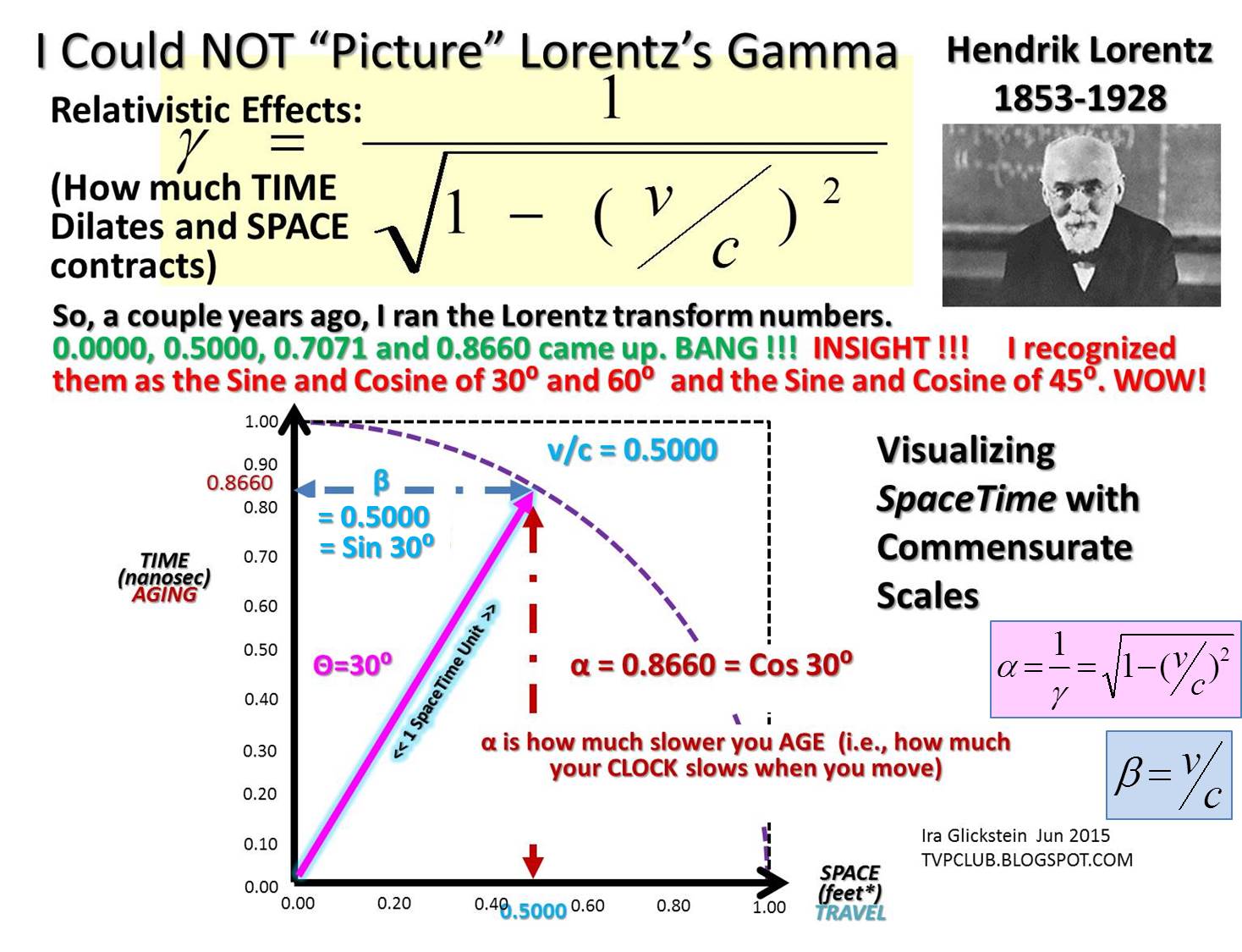
If one of two synchronous clocks at A is moved in a closed curve with constant velocity until it returns to A, the journey lasting t seconds, then by the clock which has remained at rest the traveled clock on its arrival at A will be [1 - α] seconds slow*.To VISUALIZE Einstein's thought experiment, let "A" be a location on Earth, where the stay-at-home twin resides, and the "closed curve" be the path followed by the traveling twin, moving at 87% of the speed of light (v/c = β = 0.8660) where α = 0.5 as depicted below.

LINKS TO RELATED POSTINGS AND RESOURCES
VISUALIZING Relativity - PowerPoint Show
VISUALIZING Relativity - Excel Spreadsheet
VISUALIZING for Science and Technology - Blog Posting
VISUALIZING Einstein's "Miracle Year" - Blog Posting
VISUALIZING My Insight Into Lorentz Gamma - Blog Posting
VISUALIZING the "Twin Paradox" - Blog Posting
As depicted, Blair and Aden are 20 years old when Aden takes off on a long space journey at ultra-high speed while Blair remains home. Aden's journey, at an average speed of 87% the speed of light, extends out to the vicinity of a Neutron Star (or a Black Hole) where Aden's spaceship "slingshots" and speeds back to Earth.
When Aden is at the half-way point, Blair has AGED 30 Earth-years and is 50 years old. However Aden, due to being in a state of high Kinetic Energy with respect to Blair, has AGED only 15 years and is only 30 years old.
By the time Aden returns from the journey, Blair has AGED an additional 30 Earth-years and has reached the ripe old age of 80. However Aden has only AGED an additional 15 years, and returns home a sprightly 50 year-old!
WHAT DOES THIS VISUALIZATION TELL US?
First of all, this is only a "thought experiment" and there are many practical limitations that make it unrealistic. None of our current spacecraft are capable of even 1% of the speed of light, much less the 87% imagined for Aden. Furthermore, even if we had such a spacecraft, and even if it carried only a clock and not a fragile human being, considering the G-forces involved, it would take a number of years to accelerate up to 87% of the speed of light, perform the "slingshot", and decelerate to land safely on Earth.
A more realistic depiction would include those years of acceleration and deceleration and would require some portions of the journey to be faster than 87% of the speed of light so as to average 87%.
Note that the Einstein quote is from Einstein's 1905 SPECIAL RELATIVITY paper and he (wisely) specifies that the "closed curve" be at "constant velocity". It would take an additional ten years, and Einstein's 1915 GENERAL RELATIVITY paper to account for the Relativistic Effects of the acceleration and deceleration required for a practical journey. It turns out that the acceleration and deceleration of the traveling twin in the spacecraft would actually increase the difference in AGING somewhat. However, 60 years of Earth gravity, to which the stay-at-home twin would be exposed, would actually decrease the difference in AGING a bit.
On the other hand, some of the explanations of the "Twin Paradox" I found on the Internet expose what I think are misinterpretations of inertial reference frames and simultaneity.
CONFUSION IN EXPLANATIONS OF THE "TWIN PARADOX"
Symmetry and Simultaneity Run Riot !
In my explanation above, I state that, at the half-way point, Aden, on the spaceship, has aged 15 years while Blair, on Earth, has aged 30 years. Well, some would complain, if Aden has not yet done the "slingshot" turn-around, it is improper to state anything about difference in aging between Blair and Aden since both are still in their original frames of reference! They claim a symmetry where each twin sees the other as moving and the other as having a slower clock. They claim there is no such thing as simultaneity.
Different Inertial Frames
For example, right near the top of the Wikipedia explanation:
... each twin sees the other twin as moving, and so, according to an incorrect naive application of time dilation and the principle of relativity, each should paradoxically find the other to have aged more slowly. However, this scenario can be resolved within the standard framework of special relativity: the travelling twin's trajectory involves two different inertial frames, one for the outbound journey and one for the inbound journey, and so there is no symmetry between the spacetime paths of the two twins. [My emphasis]Well, prior to the turn-around, each twin had one and only one inertial frame, not "two different inertial frames". So, does this explanation mean to say they both aged more slowly, or neither aged more slowly? Does it mean to say that, during the turn-around, the traveling twin suddenly got younger or the stay-at-home twin suddenly got older?
Sadly for me (an old engineer who cannot understand the meaning of minus two people - see the Physist/Engineer joke in my prevous posting ) YES, they do seem to think that the ages of the twins can suddenly change, based on how they do their calculations!
Gravitational Time Dilation
Further confusion in the Wikipedia explanation:
.... Explanations put forth by Albert Einstein and Max Born invoked gravitational time dilation to explain the aging as a direct effect of acceleration.According to this Wikipedia quote, the Einstein/Born explanations invoke "gravitational time dilation to explain the aging as a direct effect of acceleration." Well, the traveling twin certainly had to be accelerated and decelerated during launch and recovery and during the turn-around, and we learn from General Relativity that Relativistic Effects of gravity are equivalent to high-speed effects at certain levels of acceleration and speed. However, the amount of reduction in aging is proportional to the total length of time the traveling twin is at ultra-high speed, and the thought experiment could be lengthened to hundreds or millions of years, such that the acceleration/deceleration periods are an insignificant fraction of the travelling twin's journey.
Age Jump Instantly At the Turn-around
Yet further confusion in the Wikipedia explanation:
... For a moment-by-moment understanding of how the time difference between the two twins unfolds, one must understand that in special relativity there is no concept of absolute present. ...For different inertial frames there are different sets of events that are simultaneous in that frame. This relativity of simultaneity means that switching from one inertial frame to another requires an adjustment in what slice through spacetime counts as the "present". ...
... Just before turnaround, the traveling twin calculates the age of the Earth-based twin ... [but] ... Just after turnaround, if he recalculates, ... there is a jump discontinuity in the age of the Earth-based twin. ... [If the twins] regularly update each other on the status of their clocks by way of sending radio signals (which travel at light speed), then all parties will note an incremental buildup of asymmetry in time-keeping, beginning at the "turn around" point. Prior to the "turn around", each party regards the other party's clock to be recording time differently from his own, but the noted difference is symmetrical between the two parties. After the "turn around", the noted differences are not symmetrical, and the asymmetry grows incrementally until the two parties are reunited. Upon finally reuniting, this asymmetry can be seen in the actual difference showing on the two reunited clocks. [My emphasis]OK, the twins are far apart for much of this thought experiment so radio signals between them will take years to reach their destinations. Therefore, even if the turn-around plans have been settled and the Relativistic Effects calculated before the launch, the stay-at-home twin will not know for sure whether or not they have been successful. The spacecraft may have blown up or gone off the planned course. Similarly, the traveling twin will not know the status of the stay-at-home. The Earth may have been destroyed by a meteor, etc.
But, it blows my mind that some physicists can imagine an instantaneous jump in age by any human being (much less a clock) due to a spacecraft turning around, or a calculation based on a delayed radio message.
MY (SIMPLE) EXPLANATION OF THE "TWIN PARADOX"
Yes, if two spaceships pass in the night, all they can measure is relative speed (even if one happens to be Spaceship Earth). According to all that is currently known, observers on each spaceship will measure the other as being shorter in the direction of travel than it really is (length contraction) and that the other's clock is running slow (time dilation). I got that.
As one Internet source noted, when two cars pass on a highway and each driver looks in their rear-view mirror, the other car appears to be getting smaller. Of course, in the case of the cars, we know that neither is really getting smaller.
So, what is different in the case of the twins?
Well, for one thing, the spacecraft was loaded with fuel and the stay-at-home twin watched it blast off and accelerate. The traveling twin felt the acceleration to ultra-high speed. Due to that expenditure of fuel, the spacecraft was raised to a higher level of Kinetic Energy than it had when it was sitting on the launch pad.
Throughout its journey, the spacecraft continued at high speed relative to the Earth (assuming that any frictional losses of energy were made up by further expenditure of fuel).
I maintain that the Relativistic Effects of a slowdown of aging (clock rate) for the travelling twin compared to the stay-at-home twin is due to a relatively higher level of Kinetic Energy. (When we get to General Relativity later in this Blog series, we will learn that high levels of Potential Energy due to the acceleration of gravity have similar Relativistic Effects.)
Ira Glickstein
* Note: I've substituted "1 - α" for the equivalent, but more complex equation in Einstein's original paper, where α is the Square Root portion of the Lorentz Transformation (
 ) as described in my previous Blog posting.