Friday, June 26, 2015

VISUALIZING: General Relativity

It took some ten years for Einstein to publish an extension of his (Special) Theory of Relativity from the relatively [pun intended] simple case of constant velocity inertial reference frames to the more General case of accelerating frames of reference. His General Theory of Relativity was published in 1915.
LINKS TO RELATED POSTINGS AND RESOURCES
VISUALIZING Relativity - PowerPoint Show
VISUALIZING Relativity - Excel Spreadsheet
VISUALIZING for Science and Technology - Blog Posting
VISUALIZING Einstein's "Miracle Year" - Blog Posting
VISUALIZING My Insight Into Lorentz Gamma - Blog Posting
VISUALIZING the "Twin Paradox" - Blog Posting

Again, Einstein utilized his uncanny ability to VISUALIZE a complex situation and gain a unique insight. He recognized that:

  • Gravity is equivalent to Acceleration, and 
  • Massive bodies cause SpaceTime to CURVE in their vicinity.

He VISUALIZED a scientist, confined to a sealed box with instruments, and tasked to determine by measurements, if the box was "at rest" on the surface of the Earth, and therefore subject to Earth Gravity or in a spacecraft far from any massive object, and being accelerated at 9.8 m/s2 (32.2 ft/s2), which is the acceleration of gravity on Earth. Einstein concluded that the scientist could not make that determination.

[This is not strictly true. Given very sensitive accelerometers at head and foot level, not available in Einstein's time, the scientist would note a small difference if "at rest" on Earth because head and foot are different distances from the center of the Earth and Gravity varies as the square of the distance from the center of mass. In an accelerating spacecraft far from massive bodies, the acceleration at foot and head level would be equal.]

HOW DOES GENERAL RELATIVITY RELATE TO SPECIAL RELATIVITY?

In my research for this project, I happened upon a fact that is not prominently mentioned by many Internet expositions of Relativity. Namely that:
 the Relativistic Effects of Gravity 
in the vicinity of a massive body 
are exactly equal to 
the Relativistic Effects in a spacecraft 
(in deep space far from any massive body) 
moving at the Escape Velocity 
corresponding to that level of Gravity!

Escape Velocity from the Earth Surface is 11.2 km/s (about 25,000 MPH). It is defined as the launch speed required for a spacecraft, pointing straight up, such that it will not fall back to Earth (ignoring air friction and rotation of the Earth).

The formula for Escape Velocity from the vicinity of a massive body is the square root of 2GM/r, where G is the universal gravitational constant (6.67×10⁻¹¹ m3 kg−1 s−2), M is the mass of the body, and r is the radius from the center of the body to the spacecraft at launch.

From this equation you should be able to deduce that Escape Velocity is less if the spacecraft is flown to a position that is high above the Earth Surface, and launched there, increasing r. That is one reason for multi-stage rockets. The final stage does not fire until far from the Surface. Less obvious is that a horizontal launch requires less speed than a vertical launch. Thus, the spacecraft is usually placed into high orbit prior to the final acceleration to escape.

EQUIVALENCE OF KINETIC AND POTENTIAL ENERGY

When you throw a ball straight up into the air, at some initial vertical speed, it continuously slows until it reaches the point where its speed is zero, and then it falls, continuously increasing downward speed, until it returns to your glove. If we ignore air friction, the ball will strike your glove at the same speed as your initial throw.

This is a perfect illustration of the exchange of Kinetic Energy for Potential Energy.

Your initial throw imparts a given vertical speed to the ball. From that speed, you can compute the Kinetic Energy. As the ball rises and slows due to the force of Gravity, the Kinetic Energy is converted to Potential Energy (ignoring loss to air friction). At the highest point, the ball has zero Kinetic Energy, and maximum Potential Energy. By conservation of Energy, the Potential Energy at the peak is exactly equal to the initial Kinetic Energy of the throw. As the ball falls, the process is reversed, with the Potential Energy being converted to Kinetic Energy.

Please note that we are speaking here of the Kinetic and Potential Energy referenced to your glove height. If you happened to be near a deep hole in the ground, such as a well, you could drop the ball and it would speed as it fell, because your glove is at a higher Potential Energy level than the bottom of the well.

If the hole extended all the way through the Earth, the ball would speed, gaining Kinetic Energy (converted from the Potential Energy) until it passed the center of the Earth, where the Potential Energy would be zero, having all been converted to Kinetic Energy. The ball would continue to the other side of the Earth, trading Kinetic for Potential Energy (again ignoring air friction and assuming the ball does not touch the sides of the hole, etc.)

The first equation in the graphic is the equation you probably learned in your physics class for computing Kinetic Energy, using Newtonian physics. This equation is "close enough" for virtually all practical engineering applications on Earth. (m is the mass of the ball, and v is the initial velocity.)

The second equation is based on Einsteinian Physics, and must be used to obtain absolutely accurate results for Kinetic Energy at speeds that are a significant fraction of the speed of light. (m is the mass of the ball, and v is accounted for by ϒ. See previous posting in the Blog series for the definition of ϒ the Greek letter Gamma).

The third equation is based on the equivalence of Kinetic and Potential Energy. It solves for Potential Energy, using Einsteinian Physics, given knowledge of  G, the universal gravitational constant (6.67×10⁻¹¹ m3 kg−1 s−2), m is the mass of the body, and r is the radius from the center of the body to the ball (or spacecraft).


Ira Glickstein


Wednesday, June 24, 2015

Bernie Stopper

Bernie Stopper passed away yesterday at Hospice in The Villages, FL. He leaves his wife Nonie, daughter Robin, and son Doug, plus an unlimited number of friends from New York (IBM/Lockheed Owego, where he was my second-best manager :^) and Florida (The Villages, where he was my second-best friend and bicycling/kayaking companion :^). He will be missed.

COTTAGE ON CAYUGA LAKE (1997)

Vi and I loved to socialize with him and Nonie. As a manager, he exhibited the very best of traditional IBM ethics and thoughtfulness for his employees, plus unparalleled competence and thoroughness in all aspects of avionics engineering management and business planning. Here in The Villages, he leaves his mark as webmaster for the Village Bicycle Club site and for the "We Bike for Kids" charity, and as a great friend to so many of us.

I've been looking through my photo collection and found several that should be of interest to those of you who knew Bernie.

However, I noticed that, more often than not, it was Bernie who unselfishly took the photos of me and others at interesting events, rather than hog the spotlight.


In 1997, Bernie and Nonie hosted Vi and me at their cottage on Cayuga Lake. Fun, food and friendship was the rule.


BUSINESS TRIP TO ENGLAND (1997)

We stopped at a British Pub on our Business trip to England (with Software Engineer, Sherry  Ives).


London Underground.


CENTRAL FLORIDA RETIREMENT (2008+)

Kayaking in Florida.


Bernie took this photo of me very close to what we originally thought was a fake plastic 8-foor gator.

Well, it turned out to be real.

Read about it here: HERE!


BELGIAN BIKE BARGE BRUSSELS to BRUGES (2011)

In September 2011, Bernie and I (along with Jerry Bauer and other members of the Village Bicycle Club) did a wonderful Belgian Bicycle Barge trip from Brussels to Bruges.

Here, Bernie stands alongside our barge, the "Magnifique". There were about 20 of us, all from our club, plus an attentive crew of four, one of whom guided on our daily cycling trips.

Below, with Jerry and a not-so-private moment in Ghent.

We slept on the barge for a week, eating breakfast each morning and packing a lunch for our bicycle trip to the next port, generally about 30 miles. The cycling included stops at historic and scenic places. We'd meet the barge at the next port, enjoy a great dinner prepared and served by the crew, and repeat the process the following day.

2014

The most recent photo I have of Bernie is from this 2014 visit by Charlie and Sara Porterfield to The Villages, FL.

From Left: Charles and Sara Porterfield, Vi and Ira Glickstein, Lee and Maureen Danielson, BERNIE, Nan and Lloyd Smith.

(Nonie is missing because she took the picture!)


WE WILL MISS YOU BERNIE!

Everyone who knew Bernie, even casually, will miss him. His can-do attitude and helpfulness was positively contagious.

I, especially, will miss him. Until several months ago, Bernie was a stronger cyclist than me, even trying to keep up with our friend (and Owego colleague) Garf Cooper. Yet, he patiently bicycled with me, often two or more times a week. My Parkinson's Disease has taken a toll on my balance, and I often dismount when we have to cross a major intersection or make a sharp turn. It takes me a while to get going again, sometimes walking the bicycle to a level or downhill grade.

Yet, until several months ago, Bernie would show up at Freedom Pointe at 7:20AM on most Tuesdays and cycle up to the Springdale Pool to meet Jerry Bauer and others for our regular cycling tour of the Marion County part of The Villages, and up to the Mulberry Recreation Center pool, where I would do my deep water aerobics. He'd also meet me (and Jerry) at Mulberry at 10am on most Saturdays for our ride to Paneras in the Spanish Plaines Town Center, where we'd meet the "real bicyclists" (who took  more strenuous trips to our common destination) and enjoy coffee and sweet rolls. He'd also join me and a Freedom Pointe friend for our easy 8-mile trip starting around 11am Wednesdays.

Until Vi and I moved to Freedom Pointe, in 2012, I owned a kayak and Bernie and I would regularly paddle with The Villages Canoe and Kayak Club, or do trips on our own.

It was also our pleasure to host Bernie and Nonie for dinner at Freedom Pointe and to join them for meals at local restaurants (especially the "Bang-Bang Shrimp" at Bonefish Grill). We attended meetings of the Village Bicycle Club, the Science-Tech Club, and the Vestal-Apalachin Club.

Every time I walk down the stairs to the Freedom Pointe parking garage where I keep my bicycle, I look for Bernie where he used to wait for me.

Bernie's departure, 
for what I hope and trust
will be
 greener pastures, 
smoother roads 
and even more pleasant rivers and lakes,
 has left a big empty spot 
in my life 
and my heart 
and my soul.

Condolences to Nonie and Robin and Doug and the grandchildren from me and Vi.

Ira Glickstein

Saturday, June 20, 2015

VISUALIZING: The "Twin Paradox"

In Einstein's ground-breaking 1905 paper, On the Electrodynamics of Moving Bodies, he provides the basis for the well-known "Twin Paradox" (where one twin takes a space journey at high speeds, and finds, upon returning home, that he or she has AGED less than the stay-at-home sibling):
If one of two synchronous clocks at A is moved in a closed curve with constant velocity until it returns to A, the journey lasting t seconds, then by the clock which has remained at rest the traveled clock on its arrival at A will be [1 - α] seconds slow*.
To VISUALIZE Einstein's thought experiment, let "A" be a location on Earth, where the stay-at-home twin resides, and the "closed curve" be the path followed by the traveling twin, moving at 87% of the speed of light (v/c = β = 0.8660) where α = 0.5 as depicted below.

LINKS TO RELATED POSTINGS AND RESOURCES
VISUALIZING Relativity - PowerPoint Show
VISUALIZING Relativity - Excel Spreadsheet
VISUALIZING for Science and Technology - Blog Posting
VISUALIZING Einstein's "Miracle Year" - Blog Posting
VISUALIZING My Insight Into Lorentz Gamma - Blog Posting
VISUALIZING the "Twin Paradox" - Blog Posting

As depicted, Blair and Aden are 20 years old when Aden takes off on a long space journey at ultra-high speed while Blair remains home. Aden's journey, at an average speed of 87% the speed of light, extends out to the vicinity of a Neutron Star (or a Black Hole) where Aden's spaceship "slingshots" and speeds back to Earth.

When Aden is at the half-way point, Blair has AGED 30 Earth-years and is 50 years old. However Aden, due to being in a state of high Kinetic Energy with respect to Blair, has AGED only 15 years and is only 30 years old.

By the time Aden returns from the journey, Blair has AGED an additional 30 Earth-years and has reached the ripe old age of 80. However Aden has only AGED an additional 15 years, and returns home a sprightly 50 year-old!

WHAT DOES THIS VISUALIZATION TELL US?

First of all, this is only a "thought experiment" and there are many practical limitations that make it unrealistic. None of our current spacecraft are capable of even 1% of the speed of light, much less the 87% imagined for Aden. Furthermore, even if we had such a spacecraft, and even if it carried only a clock and not a fragile human being, considering the G-forces involved,  it would take a number of years to accelerate up to 87% of the speed of light, perform the "slingshot", and decelerate to land safely on Earth.

A more realistic depiction would include those years of acceleration and deceleration and would require some portions of the journey to be faster than 87% of the speed of light so as to average 87%.

Note that the Einstein quote is from Einstein's 1905 SPECIAL RELATIVITY paper and he (wisely) specifies that the "closed curve" be at "constant velocity". It would take an additional ten years, and Einstein's 1915 GENERAL RELATIVITY paper to account for the Relativistic Effects of the acceleration and deceleration required for a practical journey. It turns out that the acceleration and deceleration of the traveling twin in the spacecraft would actually increase the difference in AGING somewhat. However, 60 years of Earth gravity, to which the stay-at-home twin would be exposed, would actually decrease the difference in AGING a bit.

On the other hand, some of the explanations of the "Twin Paradox" I found on the Internet expose what I think are misinterpretations of inertial reference frames and simultaneity.

CONFUSION IN EXPLANATIONS OF THE "TWIN PARADOX"

Symmetry and Simultaneity Run Riot !

In my explanation above, I state that, at the half-way point, Aden, on the spaceship, has aged 15 years while Blair, on Earth, has aged 30 years. Well, some would complain, if Aden has not yet done the "slingshot" turn-around, it is improper to state anything about difference in aging between Blair and Aden since both are still in their original frames of reference! They claim a symmetry where each twin sees the other as moving and the other as having a slower clock. They claim there is no such thing as simultaneity.

Different Inertial Frames

For example, right near the top of the Wikipedia explanation:
... each twin sees the other twin as moving, and so, according to an incorrect naive application of time dilation and the principle of relativity, each should paradoxically find the other to have aged more slowly. However, this scenario can be resolved within the standard framework of special relativity: the travelling twin's trajectory involves two different inertial frames, one for the outbound journey and one for the inbound journey, and so there is no symmetry between the spacetime paths of the two twins. [My emphasis]
Well, prior to the turn-around, each twin had one and only one inertial frame, not "two different inertial frames". So, does this explanation mean to say they both aged more slowly, or neither aged more slowly? Does it mean to say that, during the turn-around, the traveling twin suddenly got younger or the stay-at-home twin suddenly got older?

Sadly for me (an old engineer who cannot understand the meaning of minus two people - see the Physist/Engineer joke in my prevous posting ) YES, they do seem to think that the ages of the twins can suddenly change, based on how they do their calculations!

Gravitational Time Dilation

Further confusion in the Wikipedia explanation:
.... Explanations put forth by Albert Einstein and Max Born invoked gravitational time dilation to explain the aging as a direct effect of acceleration.
According to this Wikipedia quote, the Einstein/Born explanations invoke "gravitational time dilation to explain the aging as a direct effect of acceleration."  Well, the traveling twin certainly had to be accelerated and decelerated during launch and recovery and during the turn-around, and we learn from General Relativity that Relativistic Effects of gravity are equivalent to high-speed effects at certain levels of acceleration and speed. However, the amount of reduction in aging is proportional to the total length of time the traveling twin is at ultra-high speed, and the thought experiment could be lengthened to hundreds or millions of years, such that the acceleration/deceleration periods are an insignificant fraction of the travelling twin's journey.

Age Jump Instantly At the Turn-around

Yet further confusion in the Wikipedia explanation:
... For a moment-by-moment understanding of how the time difference between the two twins unfolds, one must understand that in special relativity there is no concept of absolute present. ...For different inertial frames there are different sets of events that are simultaneous in that frame. This relativity of simultaneity means that switching from one inertial frame to another requires an adjustment in what slice through spacetime counts as the "present". ...
... Just before turnaround, the traveling twin calculates the age of the Earth-based twin ... [but] ... Just after turnaround, if he recalculates, ... there is a jump discontinuity in the age of the Earth-based twin. ... [If the twins] regularly update each other on the status of their clocks by way of sending radio signals (which travel at light speed), then all parties will note an incremental buildup of asymmetry in time-keeping, beginning at the "turn around" point. Prior to the "turn around", each party regards the other party's clock to be recording time differently from his own, but the noted difference is symmetrical between the two parties. After the "turn around", the noted differences are not symmetrical, and the asymmetry grows incrementally until the two parties are reunited. Upon finally reuniting, this asymmetry can be seen in the actual difference showing on the two reunited clocks. [My emphasis]
OK, the twins are far apart for much of this thought experiment so radio signals between them will take years to reach their destinations. Therefore, even if the turn-around plans have been settled and the Relativistic Effects calculated before the launch, the stay-at-home twin will not know for sure whether or not they have been successful. The spacecraft may have blown up or gone off the planned course. Similarly, the traveling twin will not know the status of the stay-at-home. The Earth may have been destroyed by a meteor, etc.

But, it blows my mind that some physicists can imagine an instantaneous jump in age by any human being (much less a clock) due to a spacecraft turning around, or a calculation based on a delayed radio message.

MY (SIMPLE) EXPLANATION OF THE "TWIN PARADOX"

Yes, if two spaceships pass in the night, all they can measure is relative speed (even if one happens to be Spaceship Earth). According to all that is currently known, observers on each spaceship will measure the other as being shorter in the direction of travel than it really is (length contraction) and that the other's clock is running slow (time dilation). I got that.

As one Internet source noted, when two cars pass on a highway and each driver looks in their rear-view mirror, the other car appears to be getting smaller.  Of course, in the case of the cars, we know that neither is really getting smaller.

So, what is different in the case of the twins?

Well, for one thing, the spacecraft was loaded with fuel and the stay-at-home twin watched it blast off and accelerate. The traveling twin felt the acceleration to ultra-high speed. Due to that expenditure of fuel, the spacecraft was raised to a higher level of Kinetic Energy than it had when it was sitting on the launch pad.

Throughout its journey, the spacecraft continued at high speed relative to the Earth (assuming that any frictional losses of energy were made up by further expenditure of fuel).

I maintain that the Relativistic Effects of a slowdown of aging (clock rate) for the travelling twin compared to the stay-at-home twin is due to a relatively higher level of Kinetic Energy. (When we get to General Relativity later in this Blog series, we will learn that high levels of Potential Energy due to the acceleration of gravity have similar Relativistic Effects.)

Ira Glickstein

* Note: I've substituted "1 - α" for the equivalent, but more complex equation in Einstein's original paper, where α is the Square Root portion of the Lorentz Transformation ( \scriptstyle{\epsilon = \sqrt{1 - v^2/c^2}}) as described in my previous Blog posting.

VISUALIZING: My Insight Into Lorentz Gamma

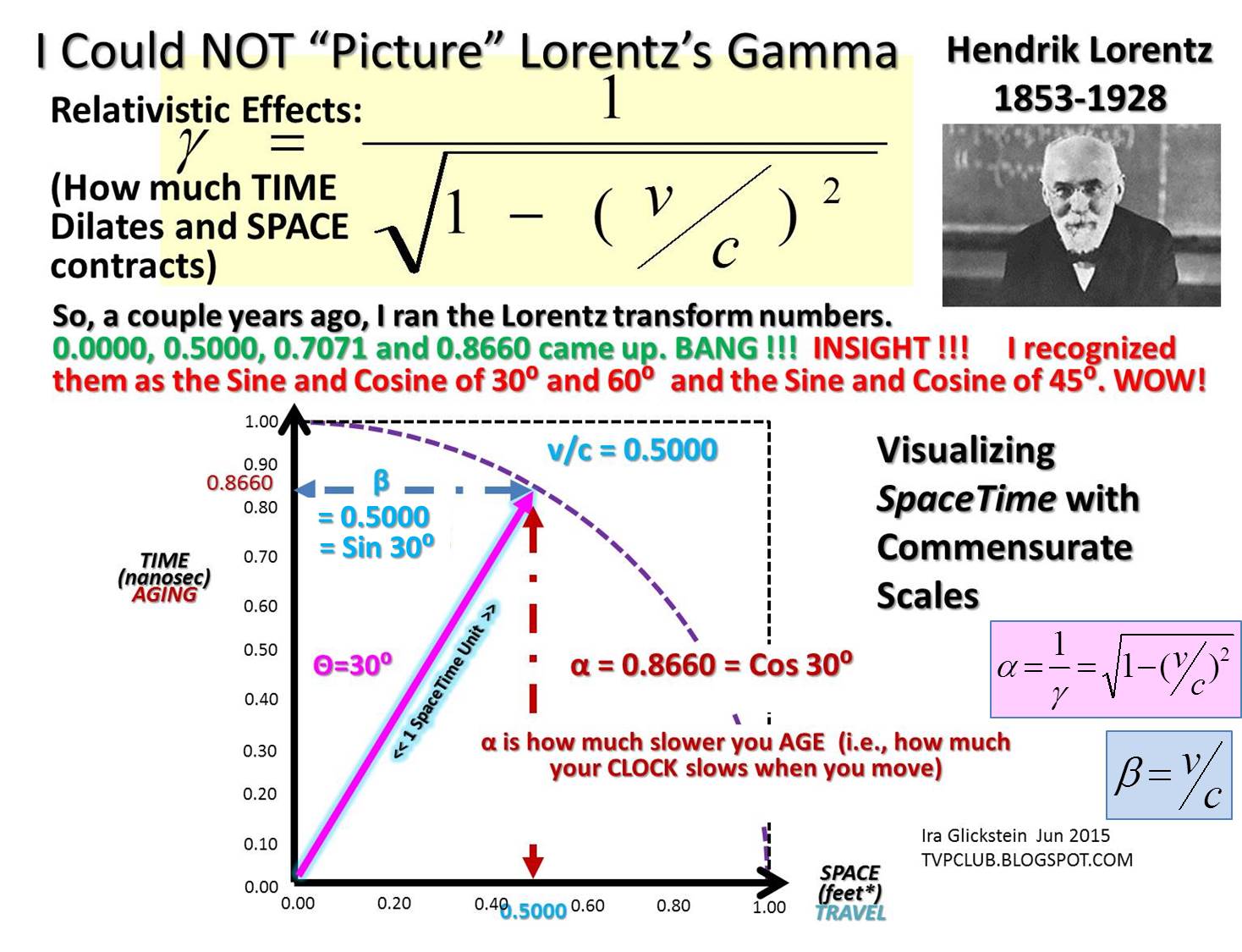
A key aspect of Einstein's Special Relativity is that, at high speeds, there is significant "Time Dilation" and "Length Contraction". In his 1905 Theory of Relativity paper, Einstein derives the equation that quantifies these Relativistic Effects, apparently unaware that Hendrick Lorentz had earlier come up with the same equation. The "Lorentz Transform" or "Lorentz Gamma" (equation near the top of the graphic below) solves for γ (Greek lowercase letter gamma) given knowledge of the relative velocity of a body (v) divided by the speed of light (c).

Simple enough, but, in my (perhaps overly anal :^) Engineering Mind it bothered me that I could not "picture" it in physical terms.
LINKS TO RELATED POSTINGS AND RESOURCES
VISUALIZING Relativity - PowerPoint Show
VISUALIZING Relativity - Excel Spreadsheet
VISUALIZING for Science and Technology - Blog Posting
VISUALIZING Einstein's "Miracle Year" - Blog Posting
VISUALIZING My Insight Into Lorentz Gamma - Blog Posting
VISUALIZING the "Twin Paradox" - Blog Posting

AN OLD JOKE

This situation reminds me of the old joke about the Historian, the Physicist, and the Engineer who happened to be waiting for a bus outside an office building. They noticed three people (a man and two women) enter the building, and, some time later, five emerge (a woman and four men).

Making conversation, the Historian asked, "How many people are in that building?"

The Physicist immediately answered, "Three went in and five came out, so there are minus two people in that building!"

The Engineer shook his head. "Mathematically correct," he noted, "But, what in hell does 'minus two people' mean?"

"Do you have a better answer?" asked the Historian.

The Engineer thought for a while and replied. "Well, if we assume that is the only entrance and exit for that building, we can deduce that, prior to our arriving here, there were at least three men in that building, and now there is at least one woman in there."

BACK TO LORENTZ

Well, a couple of years ago, I ran the Lorentz Transform for several different values of v/c and was startled to find some familiar numbers come up, among them 0.5000, 0.7071, and 0.8660.

Early in my engineering career I memorized the sines and cosines of 30⁰, 45⁰, and 60⁰. Those were the familiar numbers that popped up in my results for the Square Root of 1-(v/c)². (The fact that I still remember those numbers, half a century later, confirms how anal my Engineering Mind really is. :^)

For example, if you pick the simple case of half the speed of light (i.e., v/c = 0.5000), the Square Root term turns out to be 0.8660, which is the Cosine of 30⁰. As the graphic above illustrates, if you plot Time vs Space with commensurate scales (i.e., Time in nanoseconds and Space in feet, since, as I also memorized those many years ago, light travels about one foot in one nanosecond), a unit long SpaceTime vector, tipped 30⁰  from the Time axis, has its point at 0.5000 along the Space axis and 0.8660 along the Time axis!

SOME EXAMPLES

Let us call the Square Root part of the Lorentz Transform term α (Greek letter Alpha) from here on, and notice that α = 1/ϒ. Furthermore, let us call the v/c term β (Greek letter Beta), and the angle between the Time axis and the unit long SpaceTime vector Θ (Greek letter Theta).

For Θ = 0⁰   :  α = 1.0000 = Cos(0⁰)   and β = 0.0000 = Sin(0⁰)
For Θ = 30⁰ :  α = 0.8660 = Cos(30⁰) and β = 0.5000 = Sin(30⁰)
For Θ = 45⁰ :  α = 0.7071 = Cos(45⁰) and β = 0.7071 = Sin(45⁰)
For Θ = 60⁰ :  α = 0.5000 = Cos(60⁰) and β = 0.8660 = Sin(60⁰)
For Θ = 90⁰ :  α = 0.0000 = Cos(90⁰) and β = 1.0000 = Sin(90⁰)

So, now it all makes sense (at least to an old engineer like me :^)! All the Square Root part of the Lorentz Transform is telling us is that if we pick a value for v/c that is equal to the Sine of some angle, Θ, we'll get a value for the Square Root part that is the Cosine of that same angle, Θ.

The simple VISUALIZATION is a unit vector in SpaceTime tipped Θ⁰ from the Time axis, and it works for any Θ between 0⁰  and 90⁰.

OK, BUT WHAT IS THIS VISUALIZATION TELLING US?

In the above graphic, the Time axis extends up to 1.0, but the projection of the unit long SpaceTime vector onto the Time axis reaches only to 0.8660. So, what does α = 0.8660 tell us?

I used to have the impression that Relativistic Effects "slowed down time", and I believe quite a few of you who are reading this Blog accept that idea. However, the well known "Twin Paradox" (to be discussed in more detail the next Blog Posting in this VISUALIZING Series) tells us, IMHO, that it is not Time, per se, that "slows down" but rather AGING. For every year the stay-at-home Twin ages, the travelling twin ages only α years. So, if α = 0.8660, and the stay-at-home twin ages 10 years, the traveling twin will age only 8.66 years.

What do I mean by AGING? Well, it is simply the number read from a good-quality clock at some final Event, assuming the clock was set to zero at some initial Event, and that the clock was present at both Events. The clock may be a mechanical or electronic device, or a chemical or radioactive reaction, or a biological life form, such as bacteria, plants, or animals.

In the Twin Paradox example, both siblings are present at the separation Event and the reunion Event, each usually denoted by numerical values for t, x, y, and z, for Time and the three dimensions of Space. Thus, when reunited, they are both at the exact same Time (and Space), the only difference is how much each of them has AGED.

Ira Glickstein


Wednesday, June 17, 2015

VISUALIZING: Einstein's "Miracle Year"

In 1905 an obscure, 26-year old Assistant Examiner in the Swiss Patent Office revolutionized the world of Physics forever. Albert Einstein published four ground-breaking papers in a single year!
LINKS TO RELATED POSTINGS AND RESOURCES
VISUALIZING Relativity - PowerPoint Show
VISUALIZING Relativity - Excel Spreadsheet
VISUALIZING for Science and Technology - Blog Posting
VISUALIZING Einstein's "Miracle Year" - Blog Posting
VISUALIZING My Insight Into Lorentz Gamma - Blog Posting
VISUALIZING the "Twin Paradox" - Blog Posting

1- PHOTOELECTRIC EFFECT

This paper may be considered the foundation of Quantum Theory. Einstein theorizes that Energy is not continuous, but rather comes in DISCRETE QUANTA.

2- BROWNIAN MOTION

Statistical physics.

3- (SPECIAL) THEORY OF RELATIVITY (INVARIABILITY)

Perhaps his most important paper, On the Electrodynamics of Moving Bodies, begins with a VISUALIZATION of a magnet and a coil of wire. He notes that, when the wire is held still and the magnet is moved, an electrical voltage is produced in the wire. The opposite is also true, he notes, when the magnet is held still and the wire is moved.

Einstein's critical INSIGHT was that it was the RELATIVE movement of the wire and the magnet that induced the electrical voltage.

He knew about electrical technology because his father owned a company that manufactured electrical equipment. However, by the 1880's, when Einstein was a child, many other people had this knowledge, yet, it was not until 1905, with this paper, that the critical implications of this simple VISUALIZATION were recognized.

Of course, by the time he had the insight and wrote this paper, Einstein had a diploma in Physics and Mathematics from the Zurich Polytechnic. That enabled him to extend his insight lightyears [pun intended] beyond mere electrical technology and clarify Maxwell's electrodynamics.

Einstein proposes two startling postulates:

1) "The same laws of electrodynamics and optics will be valid for all frames of reference." and
2) "Light is always propagated in empty space with a definite velocity c which is independent of the state of motion of the emitting body."

These two postulates summarize the essence of Einstein's 1905 theory, which has come to be called his SPECIAL Theory of Relativity, to distinguish it from his later 1915 GENERAL Theory of Relativity. [Special Relativity applies only to so-called Inertial frames of reference moving at a constant speed, while General Relativity extends the ideas to frames of reference that are subject to acceleration, including the effects of gravity in the vicinity of a massive body. Some commentators including me (and even Einstein at one time :^) think these theories would have been better named the Special and General Theories of Invariability.]

The first postulate of Special Relativity establishes that ALL frames of reference are equal with respect to the applicability of the Laws of Nature. Some social commentators have, IMHO, over-interpreted the applicability of this idea, claiming that everything is relative,  including basic concepts of ethics. The actual meaning, IMHO, is the Invariability of the Laws of Nature, being the same to all observers, at all times and places.

The second postulate does away with the need for a "luminiferous ether" the then prevalent idea that light and other electromagnetic waves require a medium in which to propagate, the way sound waves require air, water or some other medium. Again, IMHO, some scientists have over-generalized that postulate to deny any concept of Absolute Space or Absolute Time. All Einstein says is that all attempts to measure the Speed of Light will yield the same value, which is another example of Invariability.

Quoting Einstein directly:
... the unsuccessful attempts to discover any motion of the earth relatively to the 'light medium,' suggest that the phenomena of electrodynamics as well as of mechanics possess no properties corresponding to the idea of absolute rest. 
and
...The introduction of a 'luminiferous ether' will prove to be superfluous inasmuch as the view here to be developed will not require an 'absolutely stationary space' provided with special properties, nor assign a velocity-vector to a point of the empty space in which electromagnetic processes take place.
Thus, while sound waves require a medium for propagation, light and other electromagnetic waves do not. For example, assume I am some distance from a wall and I make a loud, sharp sound (such as a gunshot), and then measure the return-trip time between the original sound and the echo, I will measure a shorter time in still air than I will if there is a wind blowing the air towards or away from me.

The reason for this is that, for still air, the outbound and return trip will take exactly the same amount of time, while, for moving air, it will take longer for the sound going against-the-wind, and shorter for the sound going with-the-wind.

You might think the longer and shorter changes would cancel out, but that is not so, The against-the-wind slowdown will be greater than the with-the-wind speedup. To VISUALIZE that, imagine the extreme case where the wind is blowing at the speed of sound. The with-the-wind sound will get there at twice the speed of sound, but, the against-the-wind sound will never get there!

Not so with light and other electromagnetic waves. The 1887 Michelson-Morley experiment demonstrated that there was no difference in the return trip time for light signals aligned with the 67,000 Miles per Hour motion of the Earth around the Sun and those at right angles to that motion.

Thus, there is no "ether wind", but there are differences between Kinetic (and Potential) Energy levels experienced by different Observers. 

IS THERE ANY SUCH THING AS ABSOLUTE SPACE AND TIME?

Consider the so-called "Twin Paradox", where the stay-at-home twin will have aged more than the rapidly-moving travelling twin when they are reunited. This has been explained by the fact the travelling twin changes frames of reference when he turns around to come back home. True, but, IMHO, the real difference is that the travelling twin has spent his life at a higher speed and thus a higher level of Kinetic Energy than his stay-at-home sibling, and thus aged more slowly.

Alternatively, imagine a stay-at-home twin who spends her life on the surface of a massive body, while her travelling sibling goes on a slow-speed journey to far-away empty space, living most of his life far from any massive body, and then slowly returning. Which will age more slowly? Well, in this case it is the stay-at-home twin! IMHO, the real difference is that the stay-at-home twin has spent her life at higher gravitational acceleration, and thus a higher level of Potential Energy than her travelling sibling, and thus aged more slowly.

OOPS! If you bought the above explanation you have to ask: "Higher Kinetic or Potential Energy with respect to what?" Well, at least with respect to his or her sibling! Higher Kinetic Energy is based on being at a speed that is greater than the speed of some reference point, is it not? Similarly, higher Potential Energy is based on being under the influence of gravitational acceleration that is greater than the acceleration of some reference point, is it not?

Thus there is some point (such as the Center of Mass of the Universe?) or points (such as Lagrange points L4 and L5?) that have lower Kinetic and/or Potential Energy levels than others, and are thus special in that residents will age more rapidly there. Perhaps there is a point (or points) in the Universe where aging is more rapid than ANYWHERE ELSE. At that (perhaps imaginary) point or points, residents experience Absolute Time (and/or Space) and are truly "At Rest" because they are at some Absolute Zero Kinetic and/or Potential Energy level.

[Note: Lagrange points, L1 to L5, are where the combined gravitational pull of two large masses provides precisely the centripetal force required to orbit with them. L4 and L5 are stable.]

4- EQUIVALENCE OF MATTER AND ENERGY
This paper is merely the source of the World's Best-Known Equation, E=Mc2  


CONCLUSION

Four published papers. Pretty good work for a 26-year old in a single year - or a lifetime! 


Ira Glickstein 

Thursday, May 28, 2015

VISUALIZING: for Science and Technology

Computer Model Visualization of Crash-Dummy

Nowadays it is common to use computer models, such as the crash-dummy in the adjacent image, to help us VISUALIZE and better understand complex situations and systems. Prior to the advent of computer models, we had to use mental models in our "mind's eye", along with physical aids such as paper maps and diagrams, modelling clay, and other means.

LINKS TO RELATED POSTINGS AND RESOURCES
VISUALIZING Relativity - PowerPoint Show
VISUALIZING Relativity - Excel Spreadsheet
VISUALIZING for Science and Technology - Blog Posting
VISUALIZING Einstein's "Miracle Year" - Blog Posting
VISUALIZING My Insight Into Lorentz Gamma - Blog Posting
VISUALIZING the "Twin Paradox" - Blog Posting

Albert Einstein was a great physicist, with all the requisite mathematical tools. However, he rejected purely mathematical abstraction and resorted to physical analogy for his most basic insights. For example, as part of the thought process that resulted in his theories of Special Relativity (1905) and General Relativity (1915) he imagined himself riding along a beam of light; or as an observer standing along the tracks as a train zipped by at near-light-speed; or as a scientist sealed in a closed box and not able to tell if the box was stationary on the surface of the Earth, subject to gravity, or in deep space, far from massive objects, but subject to acceleration due to being dragged by a rocket at ever-increasing speeds.
VISUALIZING the Solution
Using Math and Graphics

Of course, Einstein and virtually all scientists and technologists use mathematical abstractions to quantify the meaning in our visualization models. We change the initial conditions and run these models to simulate what may or may not happen in different situations.

COMPUTER MODELS FOR VISUALIZATION

As personal computers and the Internet have become endemic, manual typewriters, paper maps, physical books, and so much else has been displaced by automated versions. Similarly, computer visualizations and models have displaced older methods - except for that old reliable "mind's eye" which remains as important as ever.

During my career as a Senior System Engineer at IBM and Lockheed-Martin I made extensive use of computer models and visualizations and have continued to do so since retirement.

In particular, I have created visualizations for the Atmospheric "Greenhouse" Effect and Einstein's Special and General Relativity. 

VISUALIZING THE ATMOSPHERIC "GREENHOUSE" EFFECT

As a Guest Contributor to the World's most popular Climate site, I authored a four-part series on Visualizing the Atmospheric "Greenhouse" Effect that attracted over 65,000 page views and over 2000 comments (see:  Physical Analogy,  Atmospheric Windows,  Emission Spectra, and Molecules and Photons,) The following graphics are some of the animated visualizations I created for that series.   


Physical Analogy

Model of a Physical Greenhouse
Model of the Atmospheric "Greenhouse"Effect

Modeled Down to Photons and Air Molecules


VISUALIZING EINSTEIN'S SPECIAL AND GENERAL RELATIVITY


Perhaps the most well-known equation in the world is E = mc2, recognized by virtually every person. But, what does it really mean?

And, many people know about the so-called "twin paradox", where one twin goes off on long mission at high speeds into space, and comes back younger. But why does this happen and exactly what causes it?

If "everything is relative" why isn't the stay-at-home twin also also younger? So, everything is not relative, and perhaps Einstein's original name for his theories "Invariance" is more apt -for the fact all observers, including those moving at different speeds, measure the same speed for light.

If the traveling twin is younger due to experiencing high speed and acceleration, then it is aging that has slowed down, not time, per se.

Furthermore, what, precisely, is TIME? And how is TIME united with SPACE to form SpaceTime?

When you Google any of this stuff you are quickly buried in equations and tensor mathematics that no one (even an engineer like me) can really understand!

Well, all this bothered me for most of my life until, back in 2012, I decided to answer Alan Alda's Flame Challenge "What is Time?" and produce a short video. In the research process for that project, I think I had a critical insight into TIME, SPACE, and RELATIVITY that may help you VISUALIZE this important scientific theory.

Time - the fourth dimension (2013 Flame Challenge) from Ira V Glickstein on Vimeo.

Since that time, I've continued to delve into Relativity and I've come up with what I think is a unique way to visualize and ... perhaps ... even understand it. The following images are screenshots from an Excel spreadsheet I created to provide myself (and you :^) a "hands-on" experience with the relativistic effects of high speed (kinetic energy) and high acceleration (potential energy), including time dilation, length contraction, and the curvature of SPACE and TIME. It is available free.


Free Excel Spreadsheet for VISUALIZATION of Einstein's Special and General Relativity. 

Image is of the Main Panel where user selects a Star, Planet, or Set Angle Option. In the case illustrated, the SpaceTime angle is set to 30º, where velocity is half the speed of light. This causes clocks to slow down by 13.4%, which corresponds to 49 days per year or 482 seconds per hour. Right side shows Special Relativity Effects due to the Kinetic Energy of moving at half the speed of light in empty Space. Left side shows equivalent General Relativity Effects, where Time "curves" due to the Potential Energy of being "at rest" close to a Black Hole.


Free Excel Spreadsheet for VISUALIZATION of Einstein's Special and General Relativity. 

Image is of the SpaceTime view of the right side of the Main Panel (where the vector sum of TRAVEL + AGING = 1) plus the Minkowski-Like SpaceTime view (where the simple sum of TRAVEL + AGING =1).  

Free Excel Spreadsheet for VISUALIZATION of Einstein's Special and General Relativity. 
Image is of the Minkowski-Like view (described above) compared to a Planck view, where both Space and Time are assumed to be discrete, and Each tiny cell is 1 Planck Time (tP ) by 1 Planck Length (ℓP).

THE MAP IS NOT THE TERRITORY!

As my principal PhD advisor, Howard Pattee, taught me, "The MAP is NOT the TERRITORY". That sage statement means that no model is exactly the same as the thing being modeled (else it would be the real thing.)

We make models because the real thing is too complex and difficult for us to visualize, or -like the Global Climate- is not readily available for us to experiment upon.


The MAP is NOT the TERRITORY !
Many a General (or football coach) has moved symbols around on a map of the field of battle, convincing himself and his staff of inevitable victory, only to find his opponent also had a model, perhaps a better one plus superior forces to carry it to victory. 

We generally model only the most important or critical parts of the situation or complex system we are trying to visualize. We consider the model to have been successful if the results match actuality to some level of fidelity, at least for those significant portions. If subsequent testing reveals that the model does not comport with reality, we must improve or discard it.

CONCLUSION

This is the first of what I believe will turn into a series detailing my VISUALIZATION of Einstein's Relativity. Please stay tuned!

Ira Glickstein

Monday, May 18, 2015

Law, Jurisprudence, and Revolution in Islam


[From Mark Welton, based on his excellent presentation to The Villages Philosophy Club, Florida, 08 May 2015, Powerpoint available HERE. Photo above, Jameh Mosque, Yadz, Iran]

Often heard today is that the Quran contains many verses authorizing, or justifying, violence, and therefore Islam is an inherently violent religion.  This is both simplistic and wrong.

First, a hypothetical case often used in jurisprudence courses (including my own at West Point).  President Reagan said that the one law everyone needs to follow is the Ten Commandments (he did say this).  One declares “Thou shalt not commit adultery.”  Mr. Jones, a businessman, offered $10,000 to any of his married employees who obeyed this law for at least ten years.  After ten years, three couples came to Mr. Jones to claim their reward.

The first couple told Mr. Jones that the wife had never had relations with any other man after marriage, but the husband had had numerous affairs.  Nevertheless, the husband stated that when this commandment was given to Moses, Talmudic law (indeed all law throughout the Near East) held that adultery could only be committed by wives.  Married men could have as many partners as they desired without committing adultery [this is in fact correct].  Thus this commandment should be interpreted as it was understood by everyone at the time it was revealed, and the couple should receive the money since no adultery had been committed.

Should they?  (hint:  US Supreme Court Justice Scalia might say yes; laws are to be interpreted as they were understood when issued, and if people don’t like the results, the laws should be changed through democratic means, not by judicial interpretation.  But Justice Breyer would probably say no, laws are to be interpreted as they are understood by contemporary society).

The second couple told Mr. Jones that they both had many affairs after their marriage, but it was an open marriage, there was no deceit, and they loved each other and their children as much now as when they got married.  Since the purpose of the law against adultery is to preserve and strengthen the family, this purpose was met, and they should receive the money.

Should they?  (hint:  some judges today do not convict people for shoplifting if they exit a store without paying if they can demonstrate that they honestly forgot that they had the item, since the purpose of the law is to deter intentional theft, not punish innocent carelessness).

The final couple told Mr. Jones that neither of them had had any partners other than their spouses since they married.  The husband admitted, however, that he had occasionally looked at other women and felt desire, though he had never acted on that feeling.

Should they receive the money?  (hint:  the Gospel of Matthew, Pope John Paul, and Jimmy Carter have all stated that anyone who looks with lust on another person has committed adultery in their heart).

Regardless of your own opinion in these cases,  it should be evident that no law, however “clear,” has only one single possible interpretation or “plain meaning.”  Laws, like religious texts, need authorities to interpret and apply them in various situations (e.g., judges and Supreme Court Justices for U.S .law and the Constitution, the Pope for Roman Catholic doctrine, and rabbis for Talmudic law).  These authorities apply many different methodologies to interpret texts.  They also often change their interpretations over time, and they often disagree among themselves.  The process of interpreting texts (exegesis, or more broadly hermeneutics) is complex and always evolving, but never simple.

This is no different when interpreting the Quran.  The difficulty in Islam (more so for Sunnis than for Shiites) is that there is no single person or group like a Pope or a Supreme Court with authority to say what the current best interpretation of a passage in the Quran or other text should be.  Thus some “cherry pick” verses; that is, they pluck them out of the text and apply their own interpretations to justify their personal or political aims, disregarding the entire corpus of hermeneutics that has developed around them (this is called proof texting).

However, the majority of Muslims, both scholars and others, seek a more authentic contextual interpretation of the Quran and other texts so as to make them meaningful to their lives.
For example, the so-called “sword verse” (“so when the sacred months have passed away, slay the idolaters wherever you find them”) is sometimes cited to demonstrate that the Quran advocates violence.  But according to virtually all scholarly accounts, this verse was revealed late in the Prophet’s life when the small community of Muslims at Medina was under attack by the Meccans (who worshipped the many idols in the Kaaba, and were hence “idolaters”).  In the view of many who apply historical context and various other interpretive methods to this passage, when that threat ended with the surrender of the Meccans and other polytheists in the region, the non-historically constrained principles of the Quran that command respect for the other monotheistic faiths, and the exhortation that peace is better than fighting except in self-defense, take precedence over this historically conditioned verse.

This is just one illustration of the obvious point that passages extracted from the foundational texts of any legal system or religion can never be understood as having a single “plain meaning.”  Grammar, semantics, pragmatics, historicity, and other linguistic and related considerations and approaches are all necessary in interpreting the Quran, or for that matter any other foundational text.  The Quran and other textual sources of Islam have undergone centuries of study and interpretation by scholars (ulama) who sometimes, like the US Supreme Court, disagree among themselves, and who have evolved different understandings over time about the meaning of a given text.*  It was this process that created the religious/legal foundation of Muslim societies until relatively recently.

That foundation has now ruptured, with conflict, violence and extremism in some parts of the Islamic world, with many historical, social, political, and economic causes.  But to assert that Islam is an inherently violent religion because the Quran or the Sunnah clearly (or “plainly”) state such and such about fighting and violence (or any other matter) is inaccurate.


*To extract from the Quran and other texts principles and rules of Islam and Islamic law, scholars have traditionally applied numerous interpretive techniques, including al-dalalat (textual implications), naskh (abrogation), ijma (consensus), qiyas (analogical reasoning), istihsan (equity), istishab (presumption of continuity), sadd al-dhara’i (blocking the means), maslahaha (public interest), and many others.  There is nothing simple or obvious about this process.

If Islam is not intrinsically violent (see above discussion on interpreting the Quran), why is there now so much conflict in the Middle East (and in some other Islamic areas and communities)?  Obviously there is no single answer, as history, politics, economics, and religion all play a role.  But an important factor, a broader context in which these events are unfolding, is the current Islamic revolution.

In his two volume “Law and Revolution,” Harold Berman described the modern West as the product of six great revolutions: the Papal Revolution (1075-1122), the German Revolution(1517-1555) (also called the Reformation), the English Revolution (1640-1685), the French and American Revolutions of the late 18th century, and the (only partly successful) Russian Revolution of the early 20th century.  These were true revolutions in that each ultimately affected every aspect of society (economically, politically, legally, religiously, and culturally).  Like the process of scientific revolutions described by Thomas Kuhn in “The Structure of Scientific Revolutions,” they erupted when existing societies could no longer assimilate or constrain new economic, political, legal, religious and cultural ideas and forces.  They were total revolutions as they created new forms of government, new structures of economic, social, legal and state-church relations, new perspectives on history and new sets of values and beliefs.  Importantly for this discussion, each revolution was marked by violence and war; each sought legitimacy in a remote past; each took more than one generation to take root; and each eventually reverted in part to its pre-revolutionary past but also evolved in new ways thereafter.  The modern West is a product of these revolutions.

The Muslim world has undergone two such revolutions.  The first was in the 7th century ce, when the Prophet Muhammad turned the Arab world upside down.  Islam required equality instead of privilege, community instead of tribalism, monotheism instead of polytheism, law instead of private vengeance.  Like the western revolutions, this period was marked by war and violence (during the Prophet’s lifetime and in the subsequent Riddah wars), grounded itself on continuity with the past monotheistic prophetic tradition of the Near East (Judaism and Christianity), took several generations (roughly three centuries) to take root, and reverted in part to pre-Islamic patterns of tribalism, kingship, privilege and local customs, all of which were nevertheless transformed thereafter by the revolutionary ideas of Islam.

Most important, the religious/legal scholars (ulama), not the rulers, gained control of the formulation and interpretation of Islamic law, which to a remarkable degree (for the times) protected the people against the excesses of kings, sultans, and other rulers, and forced those rulers, whose task was to enforce rather than create the core religious law, to abide by that law and to restrain their arbitrary power (or they would lose legitimacy and thus the source of their power).  The “golden age” of Islam in science, literature, arts and commerce was made possible in large part by this basic “rule of law.”  

In the 19th and 20th centuries this system collapsed.  (Why the Muslim world, unlike the West, did not experience other revolutions after the era of the Prophet has many reasons; see Bernard Lewis’ “What Went Wrong” and Timur Kuran’s “The Long Divergence” for some of these reasons).  Beginning around 1800, nearly all of the Islamic world was colonized by European powers, especially by the British, French, and Dutch.  The Islamic law and its morality was almost completely replaced by western law and colonial government, partly because European colonialists desired a political and legal system more favorable to their economic and imperial interests, and partly because many Muslim reformers believed that European law was necessary for modernization.  The authority of the ulama and Islamic law disappeared, save in a few areas such as family matters, and was replaced by western legal codes and procedures, with rulers chosen or approved by the colonial powers.

The era of overt colonialism ended in the 20th century, especially after World War II.  As the Europeans left, the void was filled by various political movements: national socialists (e.g., Nasser in Egypt, the Ba’athists in Iraq and Syria), modernists (e.g., Ataturk in Turkey and Reza Shah in Iran), and others.  These were authoritarian and dictatorial, but unlike the classical era (and even under the Ottomans) there was no longer the ulama with their religious/legal authority to restrain them.  The rulers themselves now “owned” the law, had almost absolute power, but with some exceptions failed to deliver the kinds of societies most people expected.

The collapse of the old order, the effects of colonialism, the failures of political leadership, and the imposition of modernity on traditional societies led to societal pressures and fissures that, like each of the western revolutions, finally erupted in the second Islamic Revolution, beginning in 1979 in Iran and continuing throughout much of the Middle East and North Africa today.  Like the western revolutions (especially the German one, leading many commentators like Robin Wright and Reza Aslan to term the current revolution an “Islamic Reformation”), it is accompanied by violence, and a search by some for a return to the remote founding era of the Prophet (e.g., by the Salafists), or at least by many others to the “traditional” mores and values of Islam (e.g., in dress and religious observance).

Like the German and English Revolutions, when translations and dissemination of the Bible broke the exclusive power of the Church to interpret and proclaim its meaning, translations of the Quran and other Islamic texts from the old Arabic which few could read (especially the vast majority of Muslims who are not Arabs) into modern languages, and their spread through modern media like the internet and TV, have enabled everyone to read, interpret, and sometimes proclaim their own views of those texts.  New figures have emerged to engage ordinary Muslims with their faith in the modern world (such as popular Muslim “televangelists” like Moez Masoud and Amr Khaled), or to claim leadership of the revolution, ranging from modernists like the Gülen movement to radical “puritans” like Osama bin Laden.

History does not repeat itself, nor is it a predictor of future events or outcomes.  But like the great western revolutions it is likely that the current Islamic revolution, already characterized by violence and a reference to its remote past, will take more than one generation to play out and take root, and will absorb existing traditions and patterns, but will imprint those traditions and patterns with revolutionary ideas.  The results will take different forms in different places, but the process will transform the Islamic world in every respect.

Dr. Mark David Welton
Professor Emeritus

United States Military Academy, West Point
Aside from the books and authors mentioned above, all of whom are well worth reading, an excellent and relatively short book on this subject is Noah Feldman’s “The Fall and Rise of the Islamic State.”